How to Upload Your Business Card Design and Get an Editable Template
How to prepare a business card PDF that uploads cleanly to Brandly and becomes an editable template: size, bleed, live text, embedded fonts, two sides, Figma exports and fixes.
 By Brandly Team
Learn
On this page
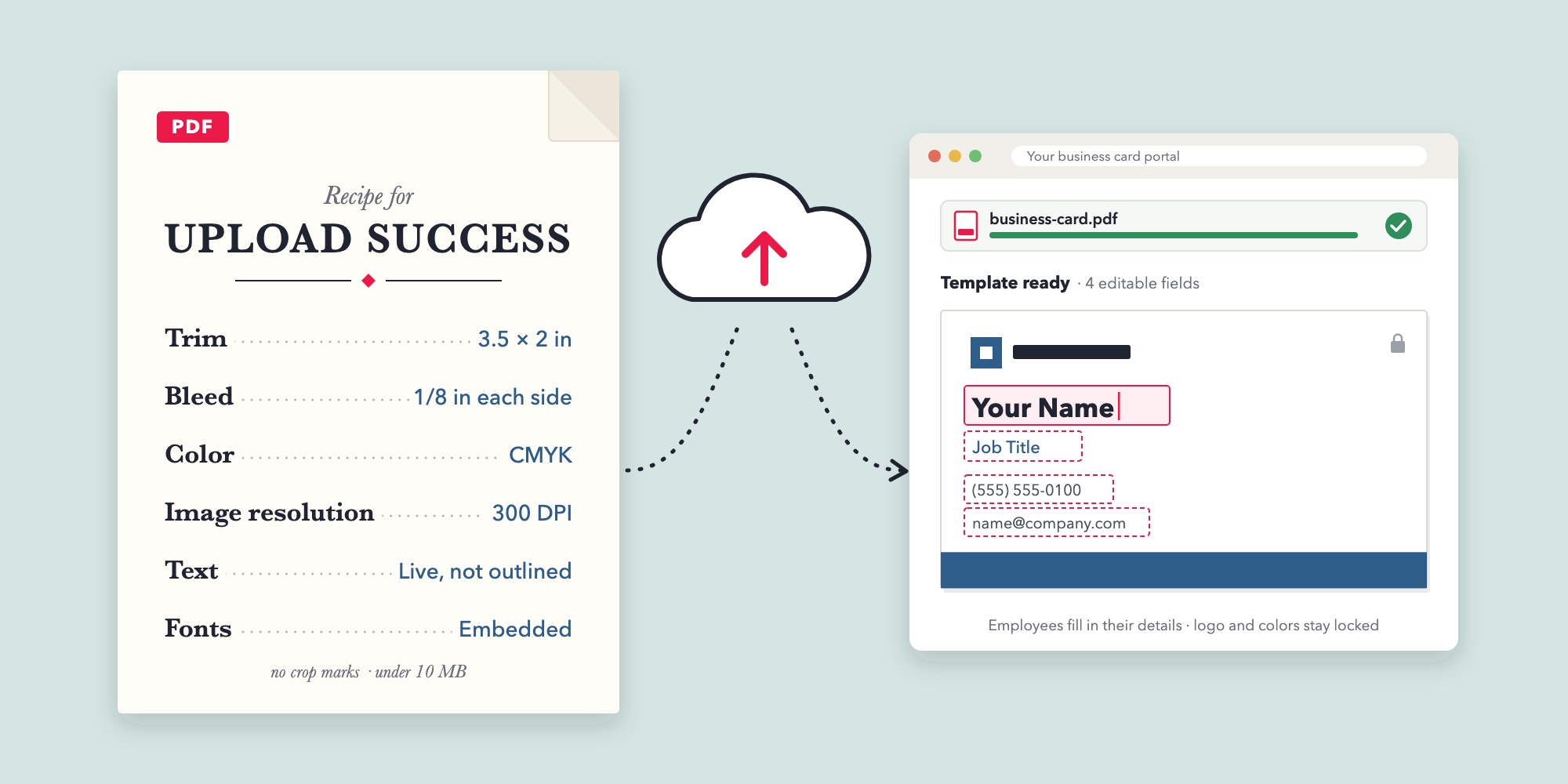
To get an editable template, upload a PDF exported from a design app at 3.75 x 2.25 inches (a 3.5 x 2 inch card plus bleed), with fonts embedded and the name, title and contact details left as live text, not outlines. Brandly turns that live text into fields your team fills in and locks everything else. Most upload problems come from outlined text, missing fonts or the wrong page size.
Brandly turns a PDF of your business card into an online template, so each employee can type in their own details and order cards that match your brand. How well that works depends almost entirely on the file you upload. This guide covers how to prepare a PDF that converts cleanly, what to check after you upload, and how to fix the most common problems.
For the whole ordering process, from sign-up to delivery, see how to order business cards online for your team.
What happens when you upload a PDF
Brandly reads your PDF and splits it into two layers:
Your PDF
Built in Illustrator, InDesign or another design app, with live text and embedded fonts.
Background layer
Logos, artwork, colors and fixed text. Locked, so it can't be changed by accident.
Type layer
Name, title and contact details become fields employees fill in, in your fonts.
The type layer uses the same fonts, sizes and colors as your design, so the printed card matches the original. Both your original PDF and the converted template are stored in your account.
The key to a good upload is simple: anything you want employees to edit must be live text in the PDF. Anything that’s an image or a shape goes into the locked background.
Before you export: get the file right
Use the right size and bleed
| US | International | |
|---|---|---|
| Page size (with bleed) | 3.75 x 2.25 in | 91 x 61 mm |
| Trim size | 3.5 x 2 in | 85 x 55 mm |
| Safe area | 3.25 x 1.75 in | 79 x 49 mm |
Set the page to the bleed size, extend any background color or image to the edge of the page, and keep text and logos inside the safe area. Vertical cards use the same sizes turned on their side. For a diagram and more detail, see business card size, bleed and safe area.
- BleedBackgrounds and images that touch the edge must run into this zone. It is cut off.+1/8 in (3 mm) on each side
- Trim lineWhere the card is cut. Your finished size is measured here.3.5 x 2 in finished
- Safe areaKeep all text, logos and contact details inside this line.3.25 x 1.75 in
Keep the editable text live
Leave the employee details (name, title, phone, email and anything else that changes) as live text. If those lines are outlined, Brandly has nothing to edit.
Live text
The text is real characters in an embedded font. Brandly turns it into a field that each employee can edit.
Outlined text
The letters have been turned into shapes. The card still prints, but there's nothing for employees to edit.
Text that never changes, such as your logo, tagline or office address, can be outlined. That locks it in place and avoids any chance of a font being swapped.
A few more text tips:
- Use one text box per line, such as one for the name, one for the title and one for each phone number. Each becomes its own field.
- Fill in realistic sample details, ideally the longest name and title on your team, so you can see how the layout holds up.
- Keep editable text at 8 pt or larger. See business card font sizes.
Embed your fonts
Make sure fonts are embedded when you export. Brandly matches the fonts in your PDF to its own font library, so employees’ details print in exactly the same typeface. If your font isn’t in the library, you’ll see a “font missing” message after uploading. Email [email protected] and we’ll look into adding it.
Set up color and images for print
- Use CMYK color, including for embedded images. Screens use RGB, printers use CMYK, and converting yourself means fewer surprises.
- Use high-resolution images, 300 to 600 DPI at the printed size. Logos are best as vector artwork.
- Keep lines at 0.5 pt or thicker, so thin rules don’t disappear when printed.
Leave out crop marks
Export only the artwork. Crop marks, printer’s marks and color bars aren’t needed and get in the way of the conversion.
Plan for two sides
Printing the back is free, so include it if you use it. You can upload:
- A two-page PDF, with the front on page 1 and the back on page 2, or
- Two single-page PDFs, uploaded separately as the front and back.
If one side is horizontal and the other vertical, check that the back is the right way up in the proof.
Exporting from your design app
| App | How to export | Watch out for |
|---|---|---|
| Adobe Illustrator | Save As or Save a Copy, as Adobe PDF (High Quality Print) | Don’t choose Create Outlines on editable text. Leave crop marks off. |
| Adobe InDesign | Export as Adobe PDF (Print), using the document bleed | Turn off crop marks and other printer’s marks |
| Figma | Use a plugin that exports real text, such as Typeport or TrueText PDF, plus Frames to Print Ready PDF for the exact size | Figma’s built-in PDF export outlines all text |
| macOS Preview | Avoid using Preview to make or re-save the PDF | It can garble text and fonts |
A note on Figma
Figma’s own PDF export draws every letter as a shape, then adds an invisible text layer so the PDF still looks selectable. That can fool you: the text highlights in a PDF viewer, but there’s no real text for Brandly to edit. The card still uploads and prints, just without editable fields.
To keep the text live, export with Typeport or TrueText PDF, and use Frames to Print Ready PDF to get the exact size. The best way to check the result is to upload it to Brandly and see whether the fields can be edited.
Files that won’t work
- Scans or photos of a printed card. They’re just pictures, with no fonts, vector logos or live text.
- Image files (JPG, PNG) saved as a PDF. Same problem as a scan.
- PDFs larger than 10 MB. Downsample oversized images and export again.
If you only have printed cards, ask whoever designed them for the original file. That’s usually your marketing team or an outside agency. Starting from scratch? Brandly’s free business card templates are ready to customize and export.
After you upload: check your template
- Look for a “font missing” message. If you see one, email us the font name.
- Click each line of text. The name, title and contact details should each be editable. If a line isn’t, it was probably outlined.
- Type the longest details on your team. Text that runs past the safe area shrinks to fit, so check that long emails and titles still look right.
- Compare the proof to your original. Check the colors, logo, alignment and the back side.
- Choose what employees can edit. Lock any fields that should stay the same for everyone.
- Place a test order before rolling out to the whole team, to confirm the colors and paper.
Fixing common upload problems
| Problem | Likely cause | Fix |
|---|---|---|
| Text isn’t editable | Text was outlined, or exported from Figma without a plugin | Re-export with live text |
| “Font missing” message | The font isn’t in Brandly’s library | Email [email protected] with the font name |
| Garbled or wrong characters | The PDF was made or re-saved in macOS Preview | Export again from the design app |
| White edges on the proof | No bleed, or the background doesn’t reach the page edge | Set the page to 3.75 x 2.25 in and extend the background |
| Card looks small or off-center | Wrong page size, or crop marks included | Export at the bleed size with no marks |
| Images look blurry | Low-resolution images | Replace with 300 DPI or higher, or vector logos |
| Colors look different | RGB artwork or images | Convert to CMYK and order a test |
| Upload fails | File over 10 MB, or a scan or image | Reduce the file size or use the original design file |
Stuck? We’ll fix it for you. If something looks wrong in the proof or the upload fails, email [email protected] or use the chat in the app. Our team will fix the file or tell you exactly what we need. Many customers simply send us their files, and we set up the template for them.
- PDF from a design app, not a scan or an image.
- 3.75 x 2.25 in page with the background extended into the bleed.
- Employee details as live text, one line per text box, at 8 pt or larger.
- Fonts embedded, CMYK color, images at 300 DPI or higher.
- No crop marks, and under 10 MB.
- Back side as page 2 or a separate PDF.
Changing your design later
When your brand changes, upload a new PDF the same way to create a new template. Admins can also make small changes in the editor, like adjusting a font size, adding a line for a second phone number, or adding a QR code. For a full redesign, go back to the original design file and upload a new PDF.
You can keep several templates in one account, such as one for each division, office or brand. Each employee orders from the templates you give them.
PDF upload FAQs
What file format should I upload?
A PDF exported from a design app such as Adobe Illustrator or InDesign, with fonts embedded and text left live. Scans, photos of a card and image files like JPG or PNG can’t be turned into editable templates.
Why can't I edit the text after uploading?
The text in your PDF was probably converted to outlines, which turns letters into shapes. This happens if someone outlined the text in Illustrator, and it’s what Figma’s built-in PDF export does. Re-export with the text left live, or send us the file and we’ll help.
What does a "font missing" message mean?
Your PDF uses a font that isn’t in Brandly’s font library yet. Brandly has most common typefaces. Email [email protected] with the font name, and we’ll look into adding it.
How big can my PDF be?
Up to 10 MB. Most business card PDFs are much smaller. If yours is larger, it usually has a very high-resolution image embedded, which you can downsample to 300 to 600 DPI at the printed size.
Can I upload a two-sided card?
Yes. Upload a two-page PDF, or upload the front and back as separate single-page PDFs. Printing the back is free. Check that the back is the right way up, especially if one side is horizontal and the other is vertical.
I don't have a PDF of our card. What can I do?
Ask whoever designed it, either your marketing team or an outside agency. They’ll have the original file and can export a PDF. If you’re starting fresh, Brandly’s free templates are a good starting point.
The takeaway
A successful upload comes down to the file. Export a PDF from your design app at 3.75 x 2.25 inches, with fonts embedded and the employee details left as live text. Then check that each field can be edited, compare the proof with your original, and place a test order. If anything goes wrong, send us the file, and we’ll fix it.
Set Up Your Free Business Card Portal
Get Started