How to Properly Display Instagram on Business Cards
How to write your Instagram handle on a business card: @username, icon + username, URL or QR code, with real examples, printing tips and advice for teams.
 By Brandly Team
Inspiration
On this page
Write your Instagram username with an @ in front, all lowercase: @yourusername. Your profile address is instagram.com/yourusername. If other social profiles appear next to it, add the Instagram icon or the word “Instagram” so people know which platform it’s on. On a business card, pair it with a QR code that opens your profile.
Every business card your team hands out is a chance to send a customer to your company’s Instagram. That’s true for a solo consultant, and it adds up fast for a company with hundreds of employees handing out cards every day.
Adding an Instagram icon and username to your business cards is an easy way to send prospects and leads to your profile, and the same goes for any other social platform you use. But what’s the best way to present that information from a design perspective, and how do you keep it consistent across a whole team?
In this article you’ll learn how to display Instagram on business cards, which format may be best for your brand, how to handle it for teams and multiple locations, and see standout examples from designers around the world. For other networks, such as LinkedIn and Facebook, see social media icons on business cards.
The most popular ways to display Instagram
In our 2020 analysis of 100 business cards that share social media information, here’s how designers chose to display Instagram:
Most popular
- @username → @brandlyinc: 50% popularity
- Icon + username → [Instagram icon] brandlyinc: 23% popularity
Other formats
The remaining 27% used a text label, a URL or another variation, such as:
- Instagram: @username → Instagram: @brandlyinc
- URL → instagram.com/brandlyinc
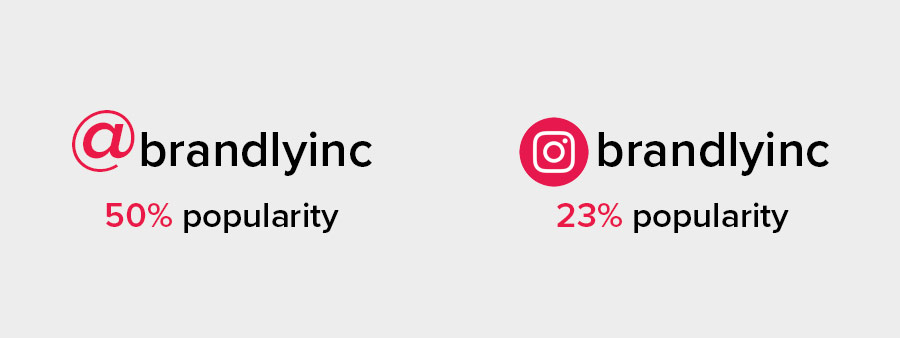
Half the designers we looked at used a plain @username, which makes it the most common approach by a wide margin.
Instagram elements you can use
When it comes to displaying Instagram on business cards, there are a few key elements that you can use. These elements can be combined in various ways to create a unique and effective design that fits your brand.
Below are the key terms we’ll use throughout this article: the Instagram logo, your username, your URL, your profile name and your Instagram QR code.
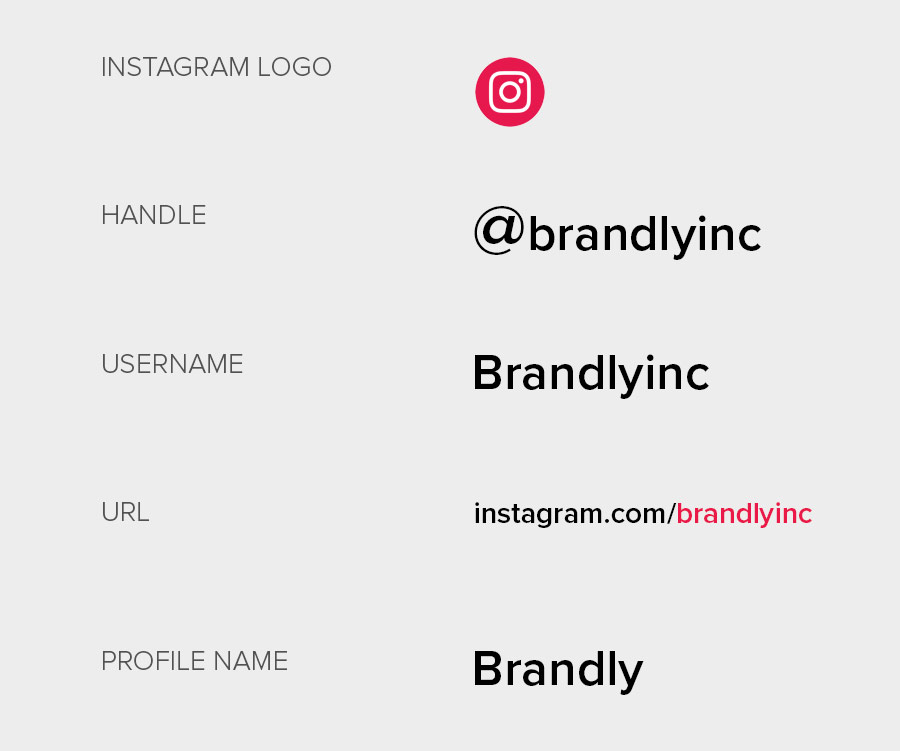
Instagram logo (icon)
The Instagram logo is an instantly recognizable element when combined with other social media information. This visual icon lets people know where to find you online. Many popular business card designs feature the logo along with a username, URL, or profile name.
Username
Your username is your unique account name, and it’s what people type to find you. It also appears at the end of your profile URL. Instagram usernames are always lowercase, so print yours that way.
You can show it two ways:
- With an @ in front (@brandlyinc). This is sometimes called a handle, and it’s the most common format on business cards.
- On its own (brandlyinc). This works when it sits next to an Instagram icon, which already tells people where to look.
| How to write it | Example | Use it when |
|---|---|---|
| @username | @brandlyinc | It’s the only social profile on the card |
| Icon + username | [Instagram icon] brandlyinc | The card lists several profiles |
| Label + @username | Instagram: @brandlyinc | You’d rather not use icons |
| Profile address | instagram.com/brandlyinc | People will type it into a browser |
URL
Instagram may be a popular mobile social media app, but you can also access the platform from a browser. In this situation, the URL would be instagram.com/yourusername. Leave off “https://” and “www” on a printed card. They take up space and nobody needs them.
Profile name
Your profile name is also your display name, and can be used to find you on Instagram. For instance, this might be your first and last name or the name of your business and will appear on your public profile.
Examples of Instagram on business cards
We have collected a few samples of how other designers used Instagram elements on a business card. Feel free to use these to inspire your own design.
The @username
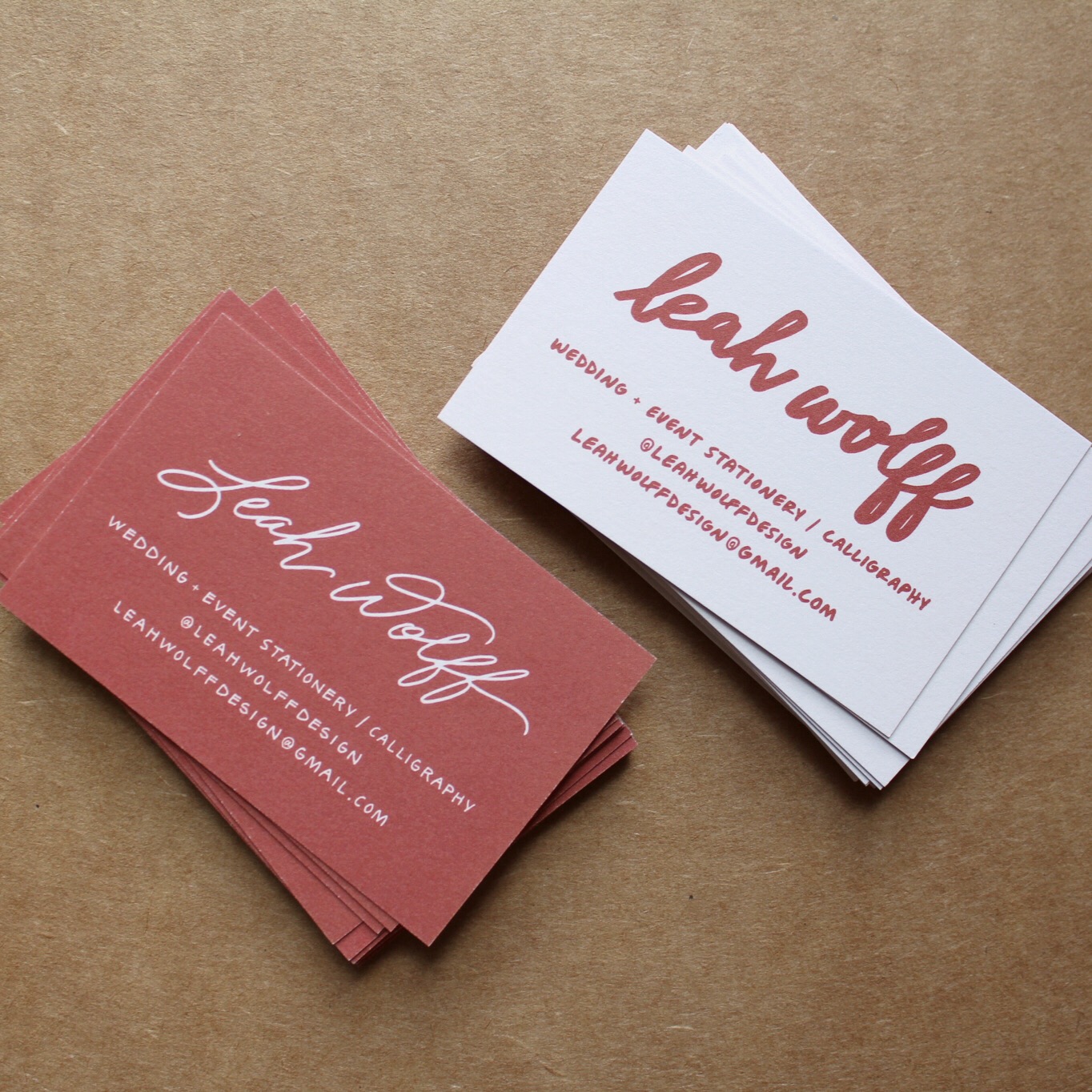
Image source: Leah Wolff Design
The @username is one of the most popular ways to display Instagram information on a business card. The plus side of this option is that it’s simple and minimal, and it’s a professional-looking way to share your profile. The downside is that you can’t assume everyone who sees a business card knows the @username is associated with Instagram. X, Threads and TikTok all use @usernames too, so on its own it doesn’t say which platform it’s on.
Icon + username
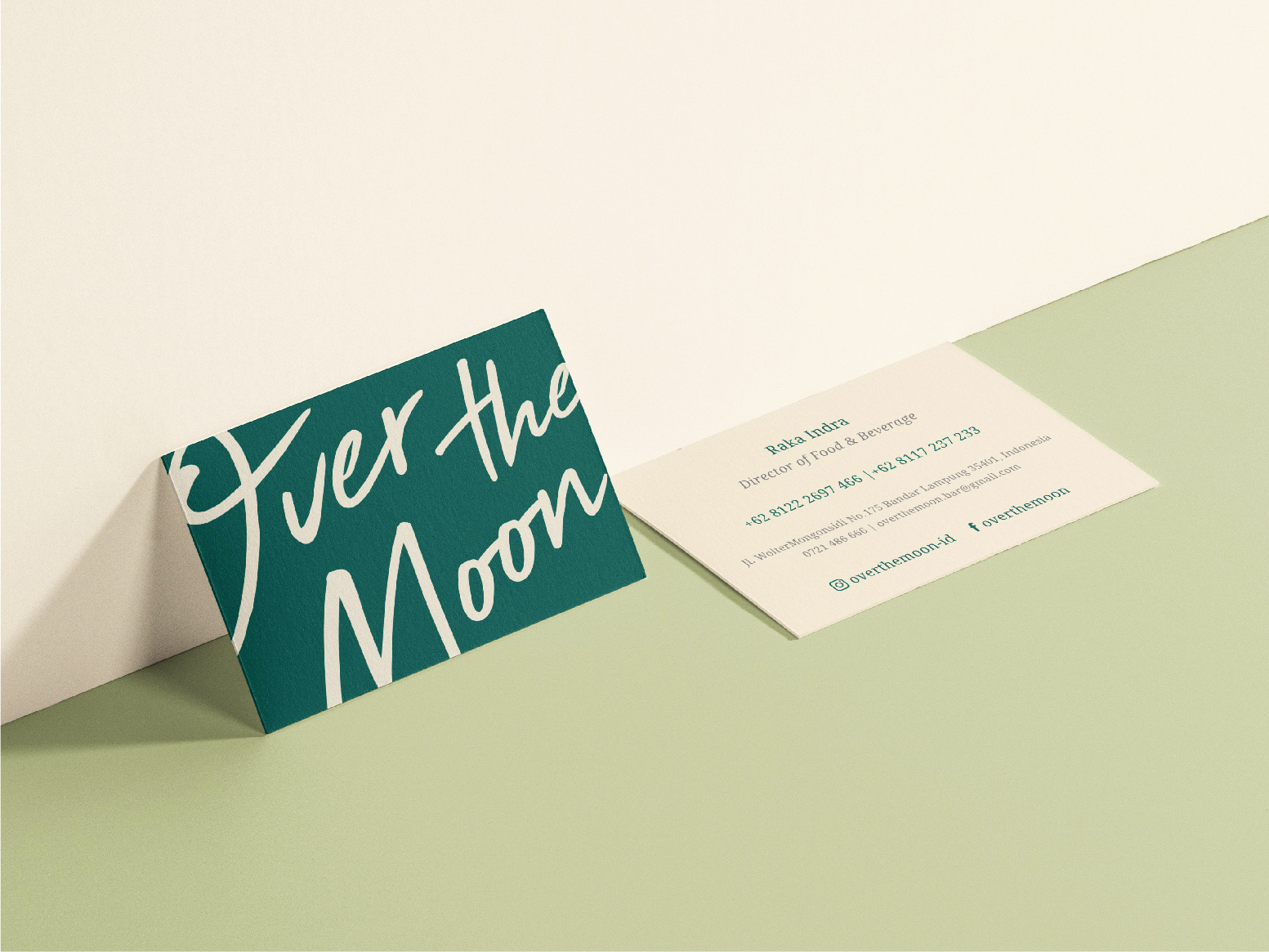
Image source: Pitu Studio for Over the Moon
Another way to show an Instagram username on a business card is displaying it next to the icon. This is the second most common method designers use. The advantage of this design is that the Instagram icon is highly recognizable so no one will have any problems understanding what it represents. The disadvantage is that if you use an icon for Instagram, you would need to use one for any other social media sites to keep the design consistent.
Tip: Use Instagram’s official glyph. Meta’s brand guidelines allow it in black, white, the official gradient, or a single solid color that matches your card. Don’t redraw, outline or otherwise change its shape.
Designing a card yourself? Our free business card icons pack has matching contact and social icons in AI and SVG.
Instagram profile URL
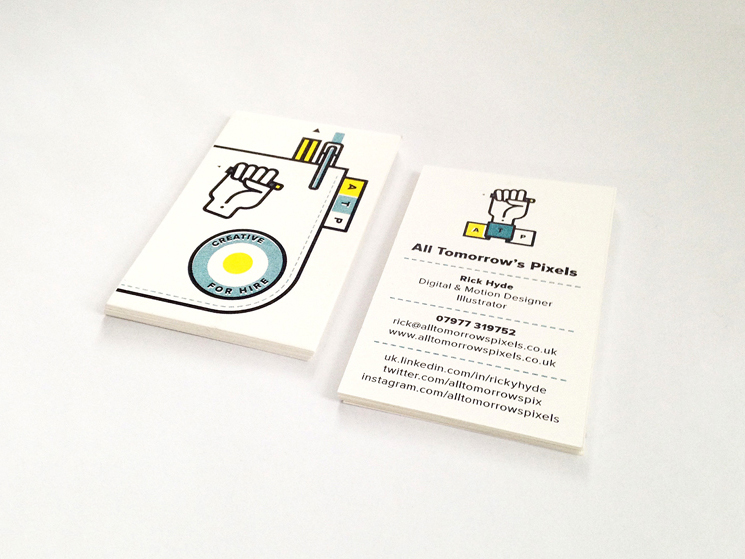
Image source: Rick Hyde for personal branding
The Instagram URL is another option, though less frequently used. The benefit of a URL is that it leads people directly to your profile without having to search by name. The tradeoff is that it takes more room than a username alone, and a typo means it won’t work.
Instagram usernames max out at 30 characters, so the URL rarely gets too long. If space is tight, a QR code is a cleaner fix than a shortened link.
Other examples

Image source: Devika Gupta for personal branding
Some designers choose to use variations on the Instagram name to display their social media username. This one uses the abbreviation “INSTA.” With no other social profiles to compete with, this design makes it easy to identify the use of an Instagram username.

Image source: Judith Jaros for personal branding
Another shortened version of the Instagram name, this designer simply uses an “i”. This design is straightforward and consistent because the same single letter abbreviation is used throughout. It is also a space-conscious way to display an Instagram username on a vertical business card.

Image source: ADM Creative Studio via Etsy
In case you can’t choose just one element for your Instagram, why not use them all? This creative example from ADM Creative Studio mimics the look of a personal profile page and uses all the elements of Instagram for a business card design.
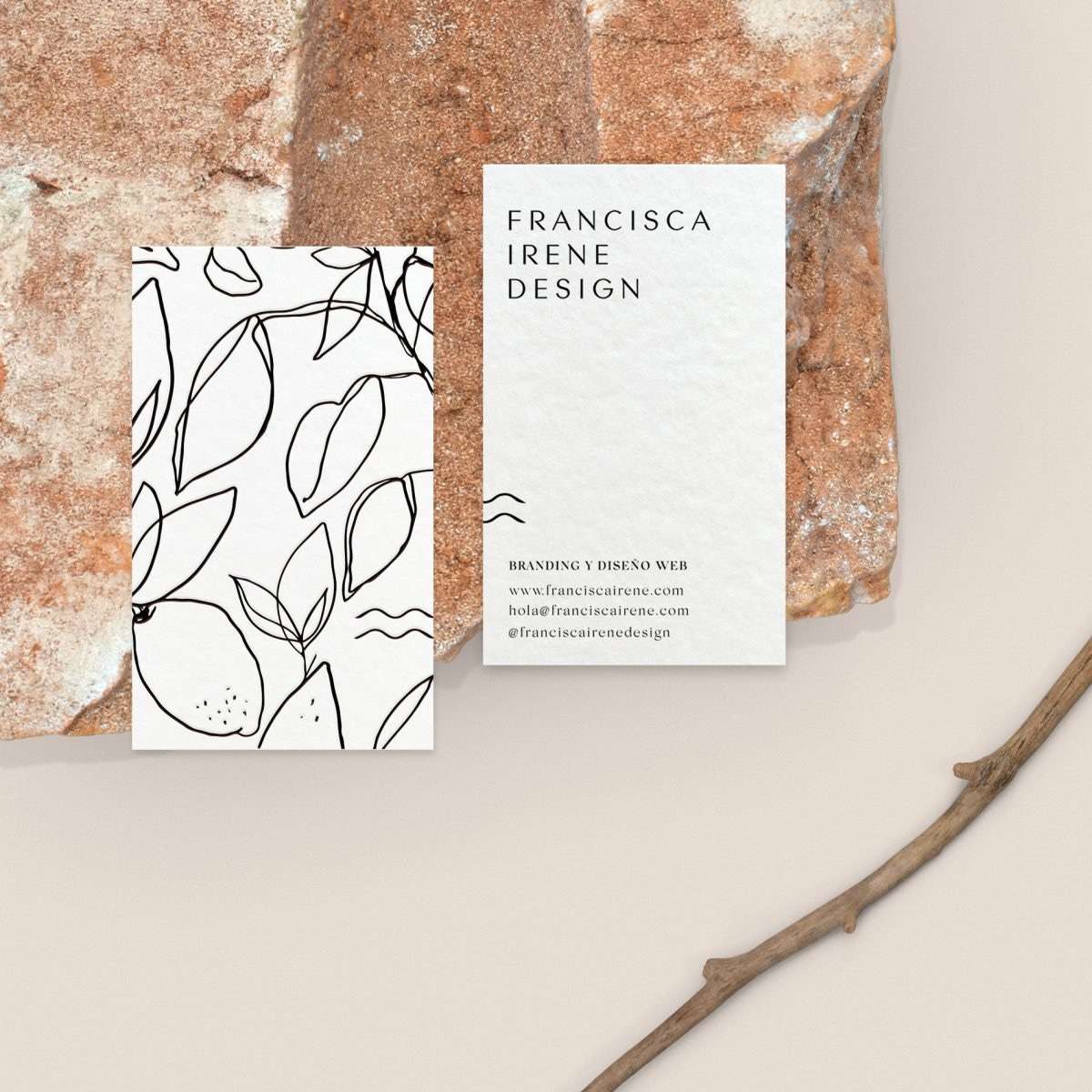
Image source: Francisca Irene for personal branding
A simple @username layout is a great fit for a simple design. In some cases, too many icons or too much information may take away from the aesthetic of a business card.

Image source: Unifikat Design Studio for Wizu
This colorful design keeps the information straightforward by using the Instagram name next to the @username for quick reference.
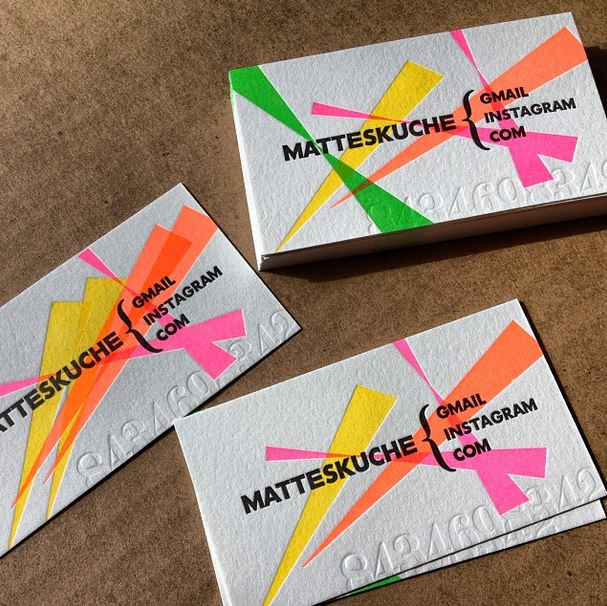
Image source: Pistachio Press
This card showcases a bright design and has the same username for all of the contact information, including email, Instagram, and web address. If your social media usernames are all identical, you may consider keeping your business card design concise—sometimes less is more.
Instagram QR code
The fastest way to turn a business card into a new follower is a QR code. Instagram used to offer “Nametags,” scannable codes that only worked inside the Instagram app. They’ve since been replaced by standard QR codes, and that change matters for print: anyone can scan the code with their regular phone camera, and it opens your profile in their browser even if they don’t have the app.
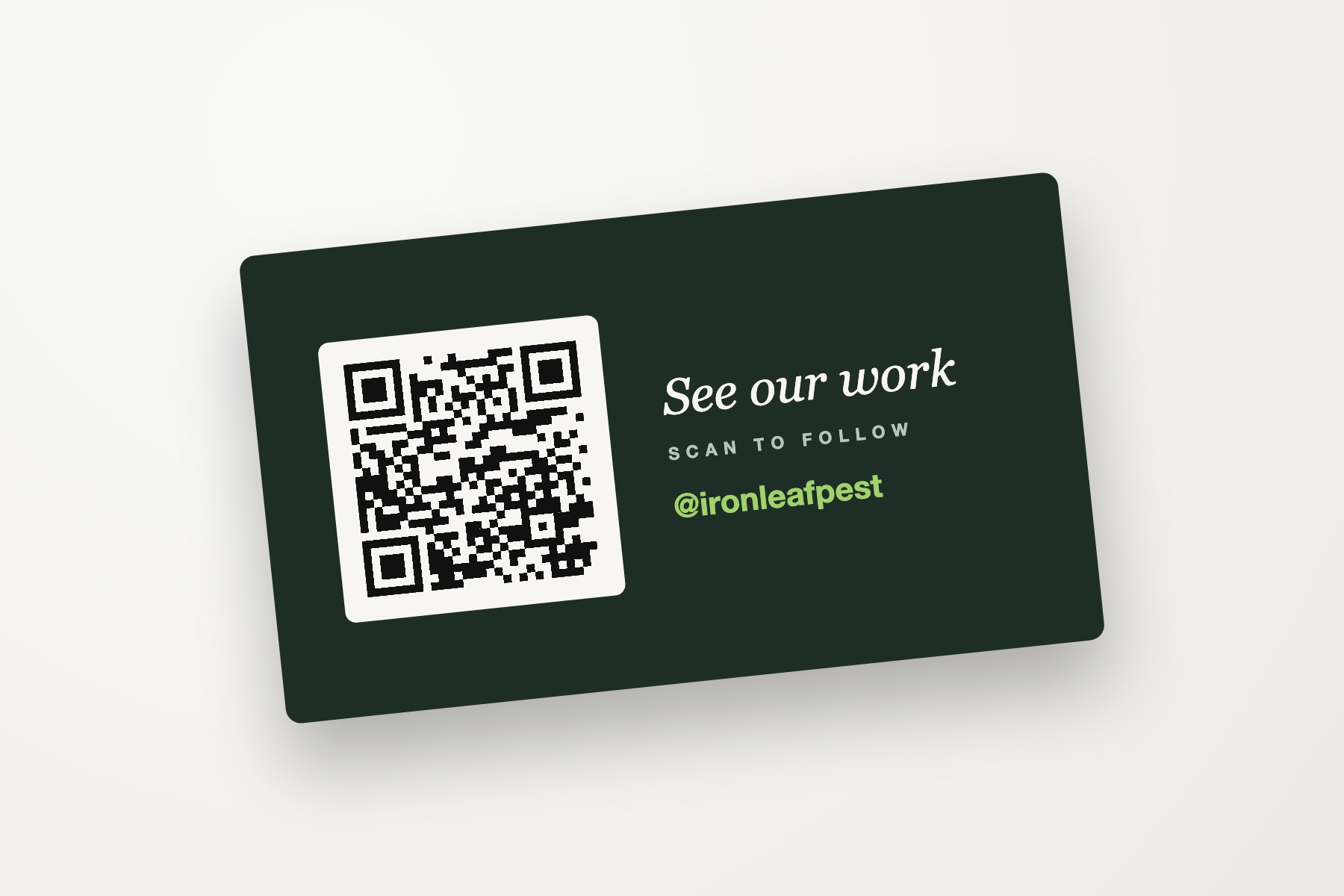
To get yours, open your Instagram profile, tap Share profile, and save the QR code. You can change its color to match your card before you download it.
A few tips for printing it:
- Size it at least 0.8 in (2 cm) square. Smaller codes get hard to scan, especially on textured stock. See how small QR codes can be.
- Keep contrast high. Dark code on a light background scans best. Avoid putting it over a photo or pattern.
- Leave a quiet zone. Keep a clear margin around the code free of text and graphics.
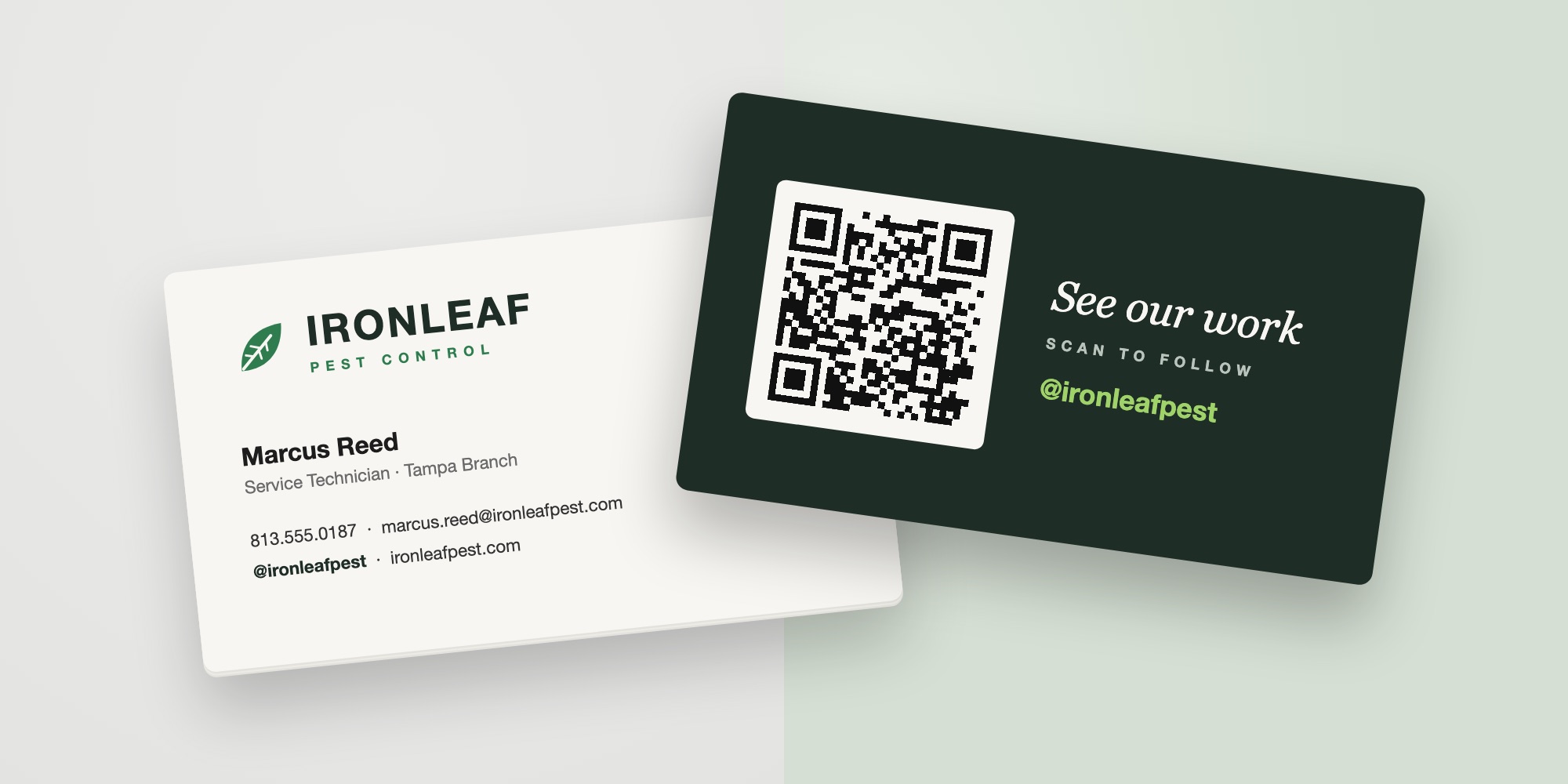
- Add a short prompt. A line like “Scan to follow” next to your @username tells people what the code does.
- Test before you print. Scan the proof with a couple of different phones.
The QR code works best alongside your @username, not in place of it, so people can still find you by typing your name.
Instagram on business cards for teams and locations
When one person designs one card, any of the formats above will work. When a company prints cards for dozens or hundreds of employees, such as a pest control company with technicians at 40 branches, the questions change.
- Decide whose account goes on the card. For most companies, it’s the company account, not each employee’s personal one. A technician’s card should send customers to your brand, and the account shouldn’t leave when the employee does.
- Plan for location accounts. If branches run their own accounts (say @ironleaftampa), make the username a field that’s filled in for each location, so offices aren’t typing their own versions.
- Set the format once, in the template. Pick one format, such as icon + @username with a QR code on the back, and lock it. That way 500 cards from 40 offices all look the same.
- Use one QR code for everyone. If the code points to the company profile, the same code prints on every card, so nothing has to be generated per employee and there’s no wrong code to print.
- Recheck after a rebrand or acquisition. Usernames change. Update the template once instead of chasing down every office’s files.
How Brandly handles social icons
On a Brandly business card portal, the Instagram icon is part of your locked template. It matches the size and color of the text next to it and prints sharp at any size. Each employee types in only the username. With vCard+, admins also choose which networks show the company account on each employee’s contact page. For the full icon set and styles, see social media icons on business cards.
Which format should you use?
| Format | Best for | Tradeoff |
|---|---|---|
| @username | Minimal designs and cards with little space | Doesn’t say which platform it’s on |
| Icon + username | Cards that list several social profiles | Every other profile needs an icon too |
| URL | People who will type it into a browser | Takes more room, and a typo breaks it |
| QR code | Turning a card into a follower in one scan | Needs space and a test scan before printing |
- Write your username in lowercase, with an @ in front.
- Add the Instagram icon or label if the card lists other profiles.
- Use the official glyph, in black, white, the gradient or one brand color.
- Add a QR code at least 0.8 in square, with “Scan to follow” next to it.
- Use the company account on employee cards, or each location’s account.
- Test-scan the proof before you print.
Instagram on business cards FAQs
How do I write my Instagram handle on a business card?
Put an @ in front of your username, all lowercase, such as @brandlyinc. If the card lists other social profiles, add the Instagram icon or the word “Instagram” next to it so people know which platform it’s on.
What's the format of an Instagram address?
Your profile address is instagram.com/yourusername, such as instagram.com/brandlyinc. You don’t need “https://” or “www” on a printed card.
Should I use the Instagram logo on my business card?
Yes, if your card lists more than one social profile, because the icon shows which username belongs to which platform. Use Instagram’s official glyph in black, white, the official gradient or one solid color that matches your card, and don’t change its shape.
Should I add an Instagram QR code to my business card?
If you have room, yes. Anyone can scan it with their phone camera, and it opens your profile even without the app. Print it at least 0.8 inches square, and keep your @username next to it so people can still type it.
Should employees put their personal Instagram on company business cards?
Usually not. Most companies print the company account on every card, so customers follow the brand and the followers stay when an employee leaves. Branches with their own accounts can fill in their location’s username.
The takeaway
There’s no single right way to put Instagram on a business card. A plain @username is the most common and the most minimal. An icon plus username is the easiest to recognize. A QR code is the fastest way to turn a card into a follower. Many cards combine an @username with a QR code to get both.
Pick the option that fits your design style and the space you have. Then get the details right: a lowercase username, the official Instagram glyph, and a test scan before you print. Choosing the right paper type and business card size matter too.
If you’re putting Instagram on cards for a whole team, a business card portal keeps the company username, icon and QR code locked on an on-brand template. Each employee or location fills in only their own details.
Set Up Your Free Business Card Portal
Get Started