Where Business Cards Ship: Location, Timing and Reorder Data from 1,500+ Companies
Original data from business card orders placed by more than 1,500 organizations from 2020 to 2026: which states cards ship to, how spread out company teams have become, the busiest months for ordering, and how often employees reorder.
 By Brandly Team
Inspiration
On this page
In business card orders from more than 1,500 organizations between January 2020 and October 2026, California (42% of U.S. companies) and Texas (40%) were the most common destinations. Company teams have spread out: the share of companies shipping cards to five or more states rose from 16% to 39%, and the share shipping outside the U.S. rose from 2% to 16%. October is the busiest month to order and December the slowest. Employees who reorder do so about every seven months, and about half of reorders are simply the same card again.
Business cards used to ship to one office. Now they go to employees in dozens of states and a growing number of countries. We looked at where and when more than 1,500 companies shipped their business card orders through Brandly, and how often their employees came back for more.
This is the third article built on Brandly’s order data. See also business card trends for paper and finishes.
About the data
- Sample: business card orders placed through Brandly by more than 1,500 organizations, January 2020 to October 2026. Only delivered or shipped orders are counted.
- Each company counts equally. Most figures are the share of companies that did something, so a few very large customers can’t skew the results.
- 2026 covers January through October.
- Reorders are measured for employees whose cards were ordered under their own name, so the same person can be followed from one order to the next.
Which states business cards ship to
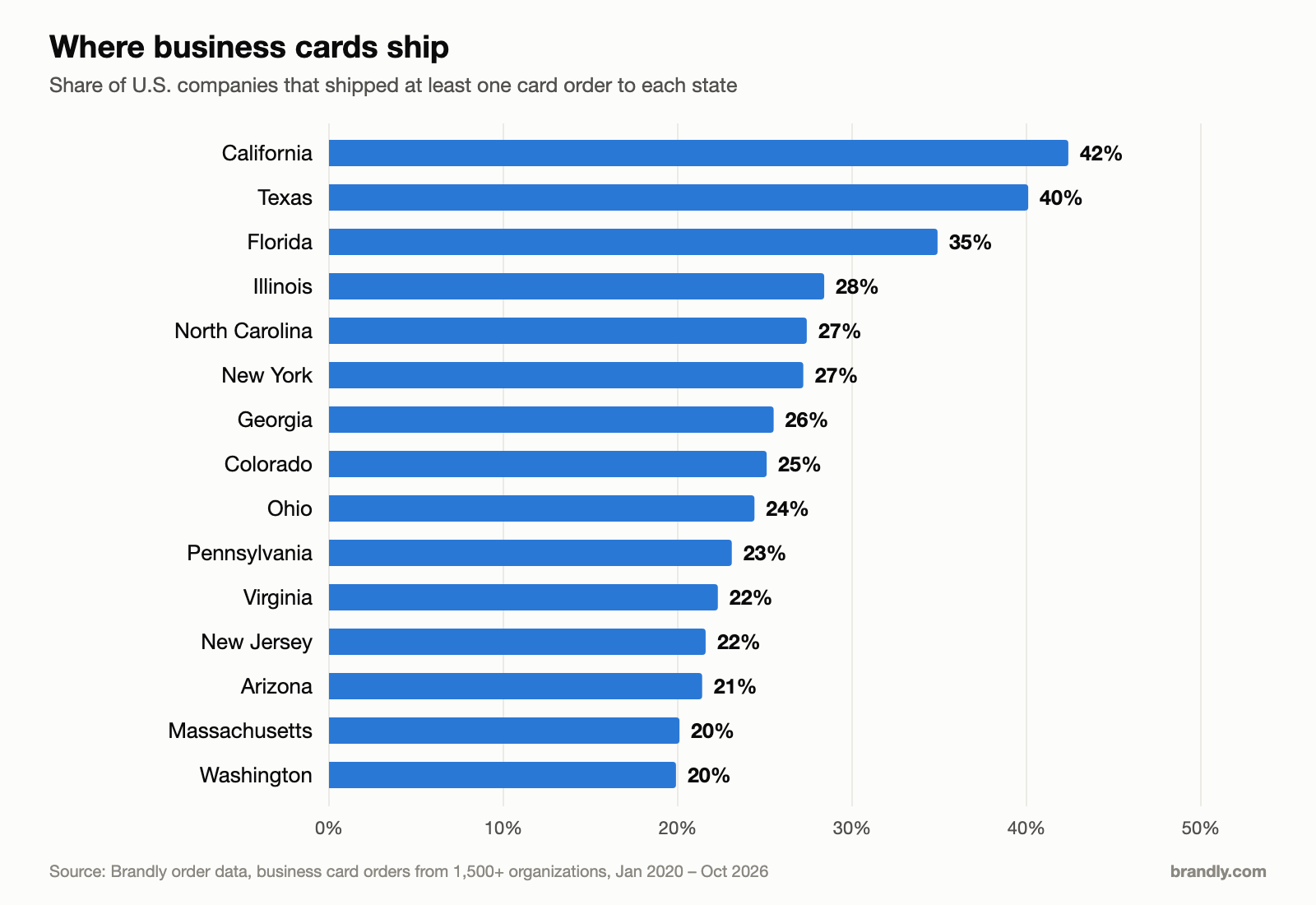
California and Texas lead by a wide margin. 42% of U.S. companies in the sample shipped at least one card order to California, and 40% to Texas. Florida is third at 35%.
After that, the list tracks the country’s biggest business hubs: Illinois, North Carolina, New York, Georgia and Colorado, each at about a quarter of companies. North Carolina and Colorado rank higher than their population alone would suggest, which fits their growth as places where companies hire.
The point isn’t that cards go to big states. It’s that one company’s cards go to many of them. A company headquartered in Chicago may have salespeople in Texas, a field team in Florida and an account manager working from home in Colorado.
Company teams are more spread out
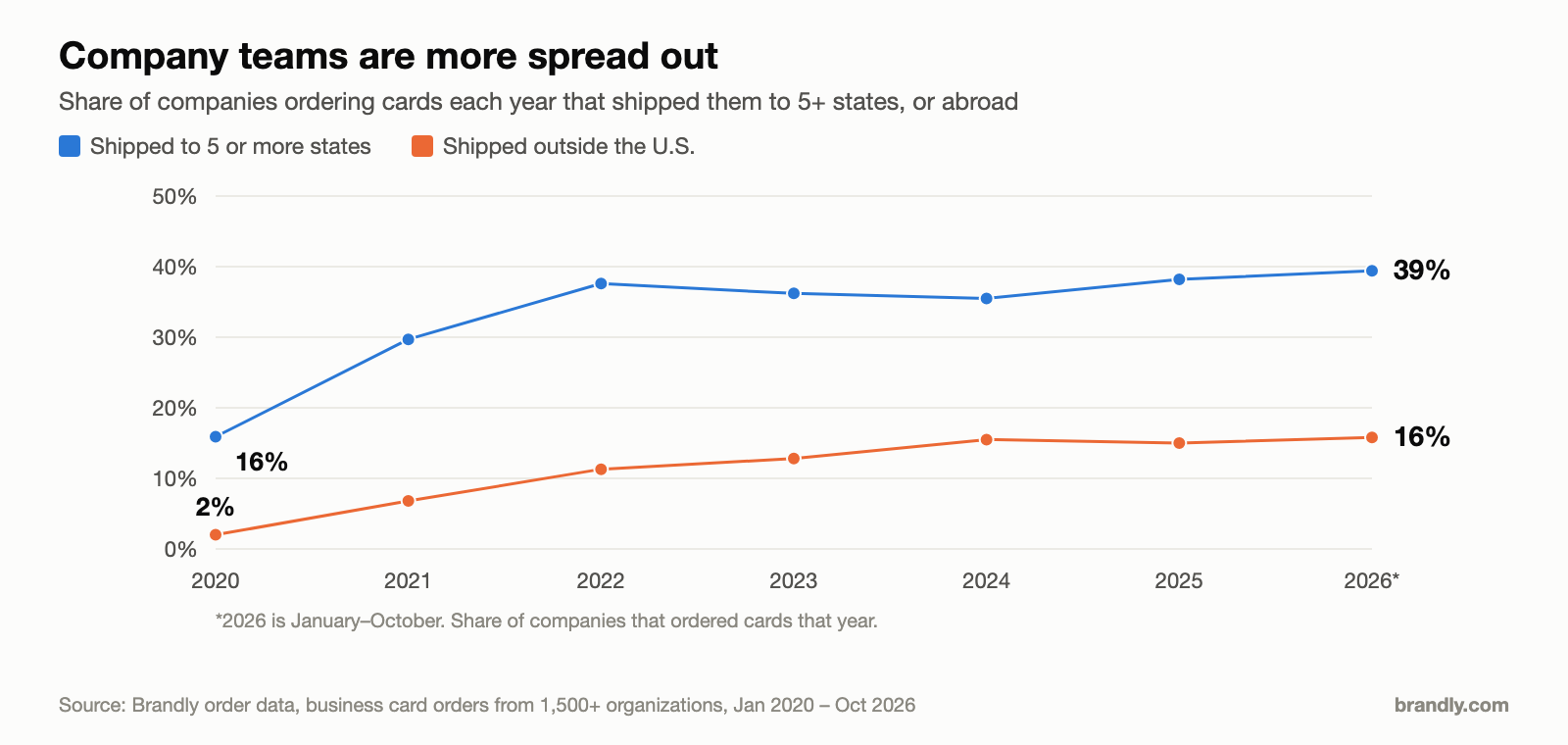
Comparing 2020 with 2026:
- Shipping to two or more states: 45% of companies ordering cards in 2020, 64% in 2026.
- Five or more states: 16% to 39%.
- Ten or more states: 6% to 19%.
- Outside the U.S.: 2% to 16%.
Most of the change happened in 2021 and 2022, as companies hired remotely and stopped assuming everyone works from headquarters. It hasn’t reversed. Even with more people back in offices, a typical company now ships cards to employees across several states.
That changes how cards get ordered. When everyone sits in one building, an office manager can order one box per person and hand them out. When people work in 20 states, it’s simpler to let each employee order their own cards from a locked company template and have them shipped to wherever they work. See how ordering works for a team and shipping to several offices.
Where cards go outside the U.S.
Among all companies in the sample, the most common destinations outside the U.S. were:
| Country | Share of companies that shipped cards there |
|---|---|
| Canada | 10% |
| United Kingdom | 7% |
| Germany | 4% |
| France | 3% |
| Australia | 3% |
| Singapore, Netherlands, Italy, Spain, Mexico | 2% each |
International orders are still a small share of all cards, about 6%, but they now show up at one in six companies a year. Brandly prints near the delivery address, so cards for a London or Singapore employee don’t have to cross an ocean.
When companies order business cards
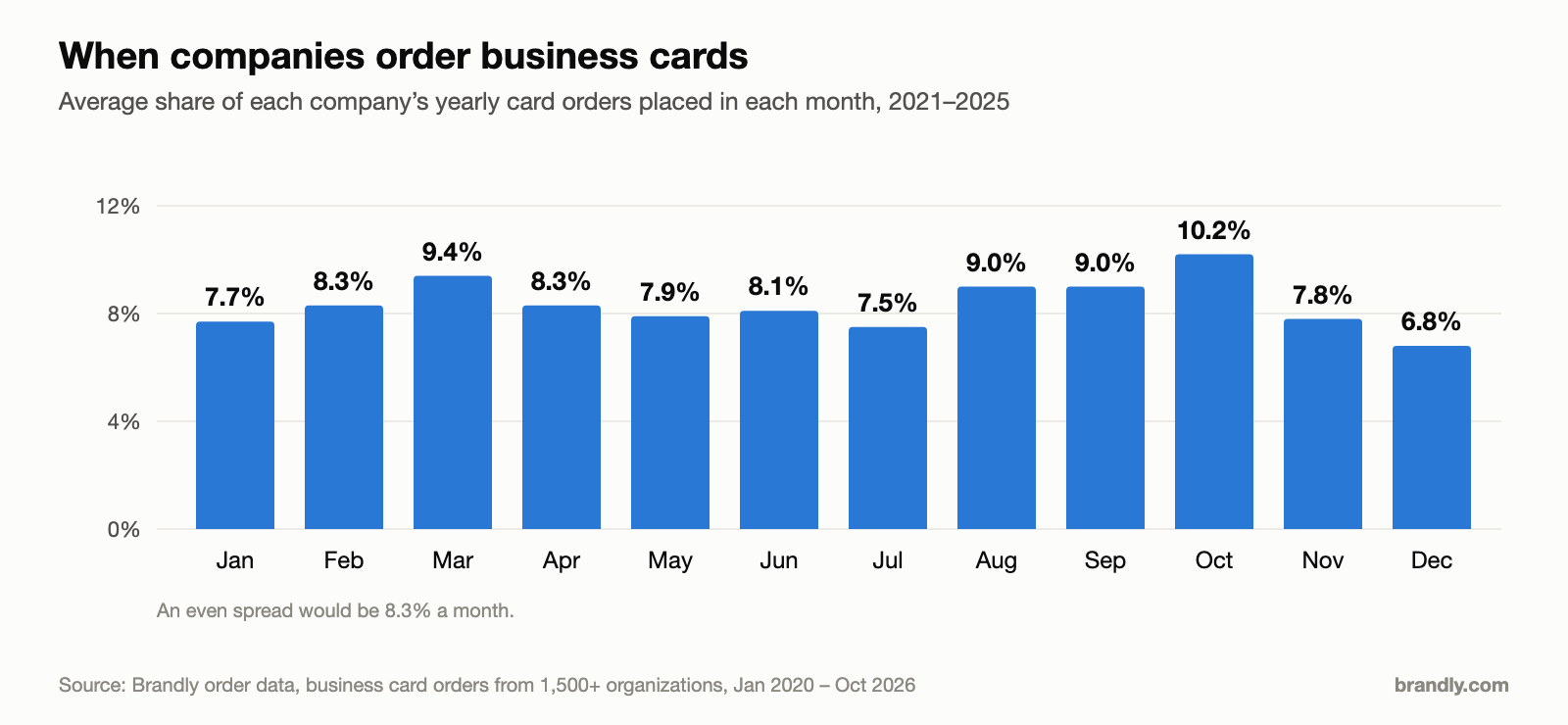
Companies order cards all year. If orders were spread evenly, each month would get 8.3%. The real pattern has a few gentle peaks:
- October is the busiest month, at 10.2% of the average company’s orders. Fall is conference and trade show season.
- March (9.4%) is the spring peak, once new-year budgets and hiring plans are in place.
- August and September (9% each) pick up as people return from summer and fall hires start.
- December is the slowest (6.8%), followed by July (7.5%).
The lesson for ordering: cards are driven by people joining and changing roles, not by a season. If your team is heading to a fall show, order a few weeks early. See the trade show calendar and how fast business cards ship.
How often employees reorder
Most employees order cards once and use them for a long time. At the typical company, fewer than 1 in 10 employees reordered during the period.
For those who do, the numbers are telling:
- About seven months between orders. At the typical company, employees who reorder come back after a median of about 210 days.
- About half of reorders are the same card again. Nothing changed: the person simply ran out, which usually means they hand out cards often.
- 38% of reorders come with a new job title. A promotion or role change is the most common reason a card has to be reprinted.
That’s why a smaller box often makes sense, even though it costs more per card. A 100-card box wastes less when titles change, and an employee who runs out can reorder in minutes. For box sizes, see how many business cards to order.
How fast business cards ship
For Brandly orders, the median time from approval to shipping was about 3 days in 2025 and 2026, and 9 in 10 orders shipped within about 5.5 days. That’s down from more than 4 days in 2021 and 2022. Shipping time comes on top of that, so plan on 7 to 10 business days in total in the U.S., or use expedited shipping. See rush orders and expedited shipping.
- California (42%) and Texas (40%) are the most common destinations for business cards.
- 39% of companies now ship cards to five or more states, up from 16% in 2020.
- 16% of companies ship cards outside the U.S., up from 2%.
- October is the busiest month to order; December the slowest.
- Employees who reorder come back about every seven months, and 38% of reorders bring a new title.
Using these statistics
You’re welcome to quote these numbers and use the charts. Please credit Brandly and link to this page:
Source: Brandly, Where Business Cards Ship: Location, Timing and Reorder Data from 1,500+ Companies (2026).
Business card shipping FAQs
Which states order the most business cards?
California and Texas. In Brandly’s order data, 42% of U.S. companies shipped business cards to California and 40% to Texas, followed by Florida (35%), Illinois (28%), North Carolina (27%) and New York (27%).
How many locations does a typical company ship business cards to?
More than it used to. In 2026, 39% of companies ordering cards shipped them to five or more states, up from 16% in 2020, and 16% shipped at least one order outside the U.S., up from 2%.
When do companies order the most business cards?
October is the busiest month, followed by March, August and September. December is the slowest. The differences are modest: companies order cards all year, mostly when people join or change roles.
How often do employees reorder business cards?
Not often. At the typical company, employees who reorder do so about every seven months. About half of reorders are identical to the last box, meaning the person ran out, and about 38% come with a new job title.
Can I use these statistics?
Yes. Please credit Brandly and link to this page, for example: “Source: Brandly, Where Business Cards Ship: Location, Timing and Reorder Data from 1,500+ Companies (2026).”
The takeaway
A company’s business cards no longer go to one office. They go to salespeople, field teams and remote employees across many states and, increasingly, other countries. That makes the old way of ordering, where one person collects names and places one big order, harder every year. With Brandly, each employee can order their own cards from your approved template and have them shipped to wherever they work, while every card still matches.