Are Business Cards Still Relevant? What 1,500+ Companies' Orders Show
Are business cards still relevant, or are digital business cards replacing them? Original data from more than 1,500 companies from 2020 to 2026 shows companies adding digital cards to paper, not swapping one for the other.
 By Brandly Team
Inspiration
On this page
Yes, business cards are still relevant. In orders from more than 1,500 companies between 2020 and 2026, about 4 in 5 companies that ordered cards one year ordered again the next, the share of cards on premium paper rose from 69% to 80%, and cards went to employees in more states than ever. Digital business cards are growing, from under 4% of companies in 2023 to 13% in 2026, but they’re being added to paper, not replacing it: companies that added a digital card ordered more printed cards the next year, not fewer.
Every year someone declares business cards dead. Phones can swap contacts, LinkedIn is a search away, and digital business cards are a QR code scan away. So are companies actually ordering fewer cards?
We looked at the business card orders of more than 1,500 companies from 2020 to 2026, including the companies that added Brandly’s digital business card to their printed cards. The answer is clear: companies are still buying business cards, buying better ones, and using digital cards to make paper more useful.
This is the fourth article built on Brandly’s order data. See also business card trends, business cards by industry and where business cards ship.
About the data
- Sample: business card orders placed through Brandly by more than 1,500 organizations, January 2020 to October 2026. Only delivered or shipped orders are counted.
- Digital card or QR means a card order that included a Brandly digital business card or a QR code. Because this is Brandly’s own feature, these figures show how fast companies adopt the option once it’s available, not the whole market.
- Each company counts equally. Percentages are shares of companies or averages per company.
- 2026 covers January through October.
The case for paper, in numbers
If business cards were fading, the data would show companies ordering less often, buying cheaper cards and giving them to fewer people. It shows the opposite:
- Companies keep coming back. About 4 in 5 companies that ordered cards in one year ordered again the next.
- They’re buying better cards. The share of the average company’s orders on premium or specialty paper rose from 69% in 2020 to 80% in 2026. Companies order fewer, better cards, and the card has to make an impression. See business card trends.
- Cards go to more people in more places. The share of companies shipping cards to five or more states rose from 16% to 39%. See where business cards ship.
- Cards aren’t just for executives. About two-thirds of cards go to individual contributors and managers, and a quarter to salespeople. See business cards by industry.
What has changed is what’s printed on the card. Between 2020–2022 and 2025–2026, cards with a street address fell from 30% to 23% of the average company’s orders, and cards with two or more phone numbers fell from 26% to 19%. The card is getting simpler, and the details that change often are moving online.
Digital business cards are growing
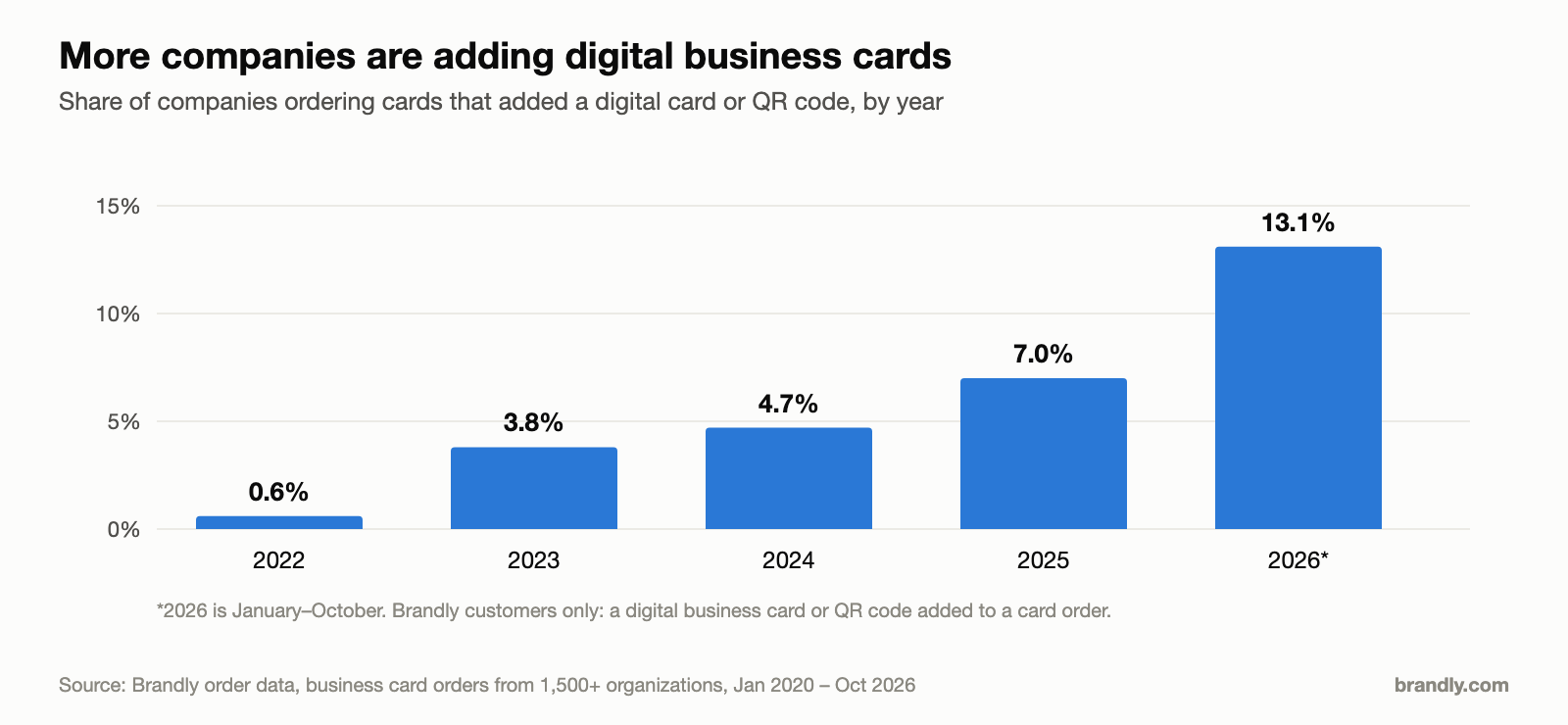
Digital cards are catching on fast. Among Brandly customers, the share of companies that added a digital business card or QR code to their printed cards went from under 4% in 2023 to 13% in 2026, and it nearly doubled in the last year alone.
Once a company adds one, it uses it widely. At companies that had a digital card, more than half of their 2026 card orders included one.
Digital cards haven’t replaced paper
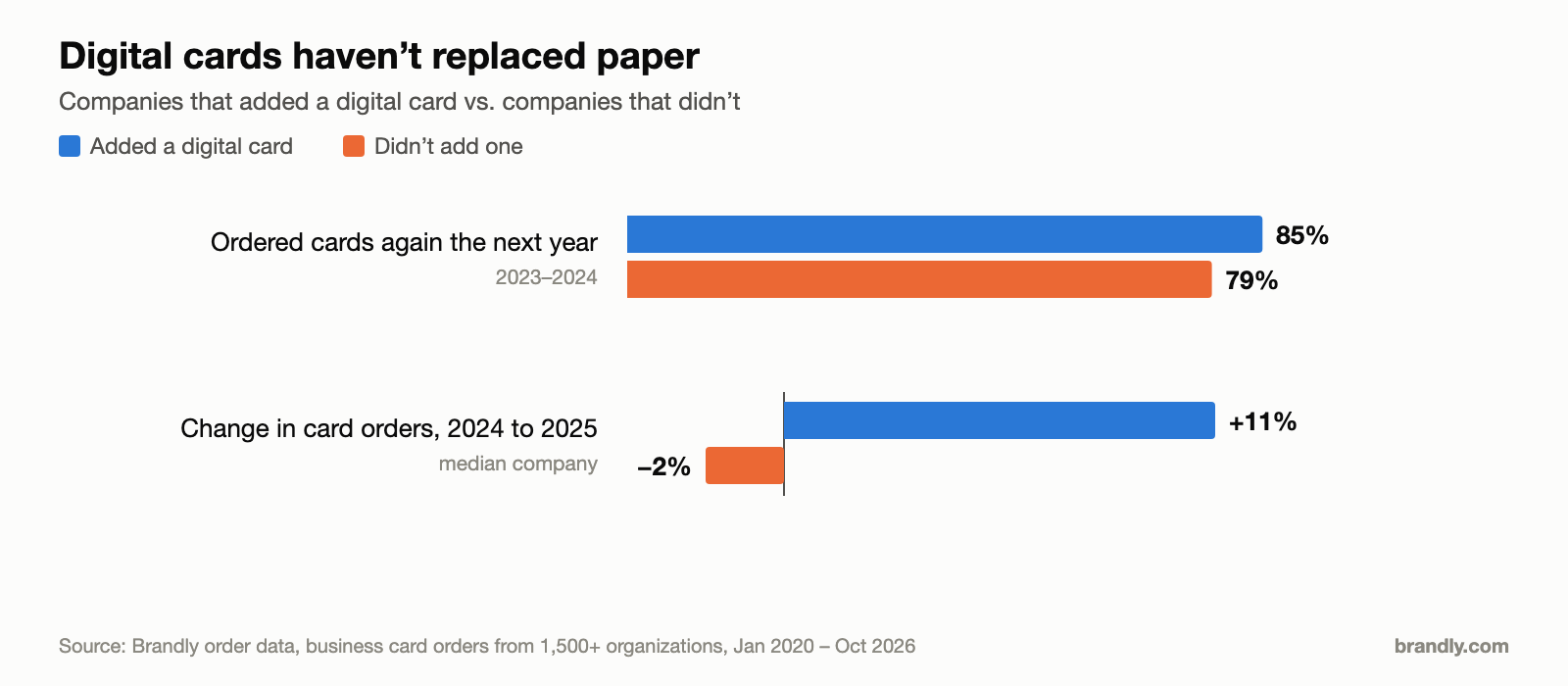
If digital cards replaced paper, companies that adopted them would order fewer printed cards afterward. They didn’t:
- They were more likely to keep ordering. 85% of companies with a digital card ordered printed cards again the next year, compared with 79% of companies without one (2023–2024).
- Their card orders grew. From 2024 to 2025, the median company that added a digital card in those years placed 11% more card orders. The median company that didn’t changed by −2%.
Two caveats: the group that adopted digital cards in 2024–2025 is small, and companies that try new features may simply be more engaged customers. But there’s no sign of digital cards eating into paper. Companies use them together: the printed card makes the introduction, and the QR code on it saves the contact.
Which industries use digital business cards
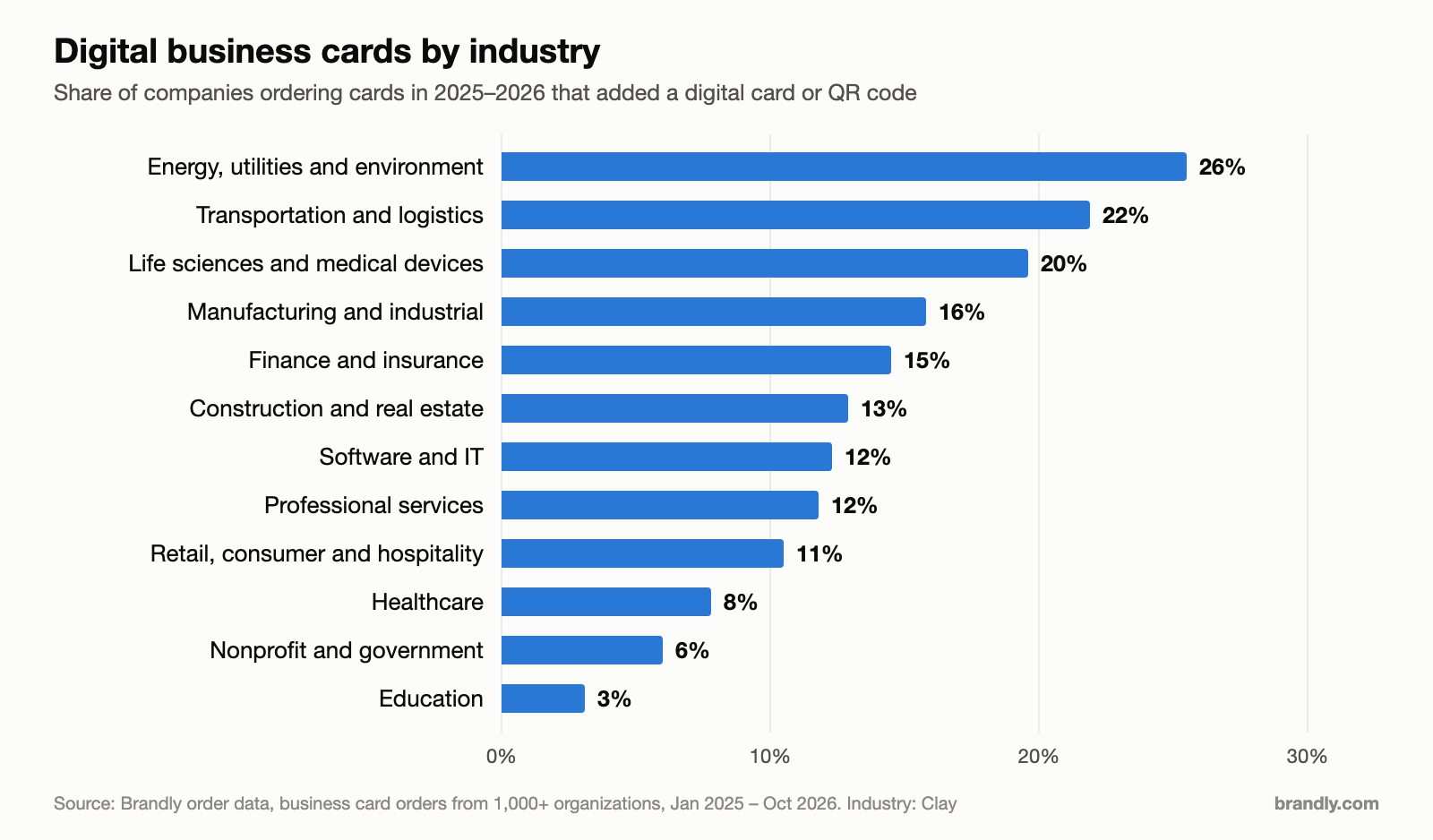
Digital cards are most popular in energy and utilities (about 1 in 4 companies ordering in 2025–2026), transportation and logistics (22%) and life sciences (20%). These are industries with sales reps and field teams who meet many people in person, at sites, trade shows and hospitals, where saving a contact in one scan is useful.
They’re least common in education (3%), at nonprofits (6%) and in healthcare (8%), the same budget-conscious sectors that choose standard paper most often. Software companies sit in the middle at 12%, which may surprise anyone who expects tech companies to go all-digital first.
Why paper cards still matter
The data shows companies still buy cards. These are the reasons they do:
- A paper card can be left behind. After a sales call, a site visit, an open house or a trade show conversation, a printed card stays on the desk, in the folder or on the fridge. A digital card only exists if someone remembers to scan it.
- It works for everyone, instantly. No app, no signal, no fumbling for the right screen. You hand it over, and the other person has it.
- It shows someone is part of the team. Getting your business cards is a small onboarding milestone. It tells customers the person is authorized to represent the company, and it keeps titles official. See business cards for employees.
- It carries the brand. A well-made card on premium paper says something about the company that a contact entry can’t. That’s why more companies choose premium paper every year.
When a digital card helps
Digital cards are best at what paper can’t do: they can be updated without reprinting, shared over video calls and email, and saved to a phone in one tap. The strongest setup is both:
- Print a card with a QR code that opens the person’s digital card. Someone who wants paper keeps the card; someone who wants a contact scans it.
- Keep the printed card simple. Name, title, one phone number and email. Put changeable details, such as a calendar link or social profiles, on the digital card.
- Use the digital card on its own for virtual meetings, email signatures and events where you’ve run out of cards.
See QR code business cards that save your contact and how small a QR code can be.
- About 4 in 5 companies that order cards one year order again the next.
- Premium paper rose from 69% to 80% of the average company’s orders (2020–2026).
- Digital card adoption grew from under 4% of companies in 2023 to 13% in 2026.
- Companies that added a digital card were more likely to reorder (85% vs. 79%) and ordered more printed cards, not fewer.
- Digital cards are most common in energy, transportation and life sciences.
Using these statistics
You’re welcome to quote these numbers and use the charts. Please credit Brandly and link to this page:
Source: Brandly, Are Business Cards Still Relevant? What 1,500+ Companies’ Orders Show (2026).
Are business cards still relevant? FAQs
Are business cards still relevant?
Yes. In Brandly’s order data from more than 1,500 companies, most companies that order cards order again the next year, more of them choose premium paper every year, and cards now go to employees in more states than before. Digital business cards are growing, but companies add them to printed cards rather than replacing them.
Do people still use business cards?
Yes, especially people who meet customers in person: salespeople, account managers, field teams and executives. A printed card can be left behind after a meeting or site visit, which a digital card can’t do, and it shows someone is an official member of the team.
Are digital business cards replacing paper?
Not in this data. Among Brandly customers, the share of companies adding a digital card or QR code to their printed cards rose from under 4% in 2023 to 13% in 2026. Companies that added one were more likely to order cards again the next year (85% vs. 79%), and their card orders grew rather than shrank.
Should I put a QR code on my business card?
If the people you meet would rather save your contact on their phone, yes. A QR code that opens a digital card lets someone save your details in one tap, and you can update the page without reprinting your cards.
Can I use these statistics?
Yes. Please credit Brandly and link to this page, for example: “Source: Brandly, Are Business Cards Still Relevant? What 1,500+ Companies’ Orders Show (2026).”
The takeaway
Business cards aren’t going away; they’re changing. Companies print less contact detail, choose better paper, send cards to employees wherever they work and add a QR code that links to a digital card. The companies in this data didn’t choose between paper and digital. They used both, and kept ordering. With Brandly, you can give every employee matching printed cards and a digital card from the same template, so the card and the scan say the same thing.