Business Cards by Industry: Job Titles and Habits from 1,000+ Companies
Original data from business card orders placed by more than 1,000 companies from 2020 to 2026: the most common job titles on business cards, who gets cards by seniority, and how card habits differ by industry.
 By Brandly Team
Inspiration
On this page
In business card orders from more than 1,000 companies between January 2020 and October 2026, the most common job title was Chief Executive Officer (on cards at 18% of companies), followed by Account Executive (13%) and Account Manager (12%). Most cards go to individual contributors and managers, and about a quarter go to sales roles. Industries differ sharply: healthcare and transportation companies order the most cards, software and finance companies choose premium paper most often, healthcare cards carry credentials five times as often as average, and nonprofits are the most likely to print pronouns.
Who actually gets a business card, and does it depend on the industry? We looked at the job titles employees typed into their cards on Brandly and matched each company to its industry. Here’s what more than 1,000 companies ordered, from software firms and hospitals to construction companies and nonprofits.
This is the second article built on Brandly’s order data. The first, business card trends, covers paper, finishes and box sizes across all companies.
About the data
- Sample: business card orders placed through Brandly from January 2020 to October 2026. Only delivered or shipped orders are counted.
- Job titles come from about 900 companies whose employees entered their details in a Brandly template. Titles are standardized, so “CEO” and “Chief Executive Officer” count as the same title, as do “Sr.” and “Senior.”
- Industry comes from public company data (LinkedIn industry categories, via Clay), grouped into 13 sectors. More than 1,000 companies had an industry match.
- Each company counts equally. Percentages are averaged per company, so one very large customer can’t skew a result. Companies that share a website count as one.
- Media and entertainment had too few companies to report on its own. Education and transportation have smaller samples (about 30 to 40 companies each), so read their figures as directional.
The most common job titles on business cards
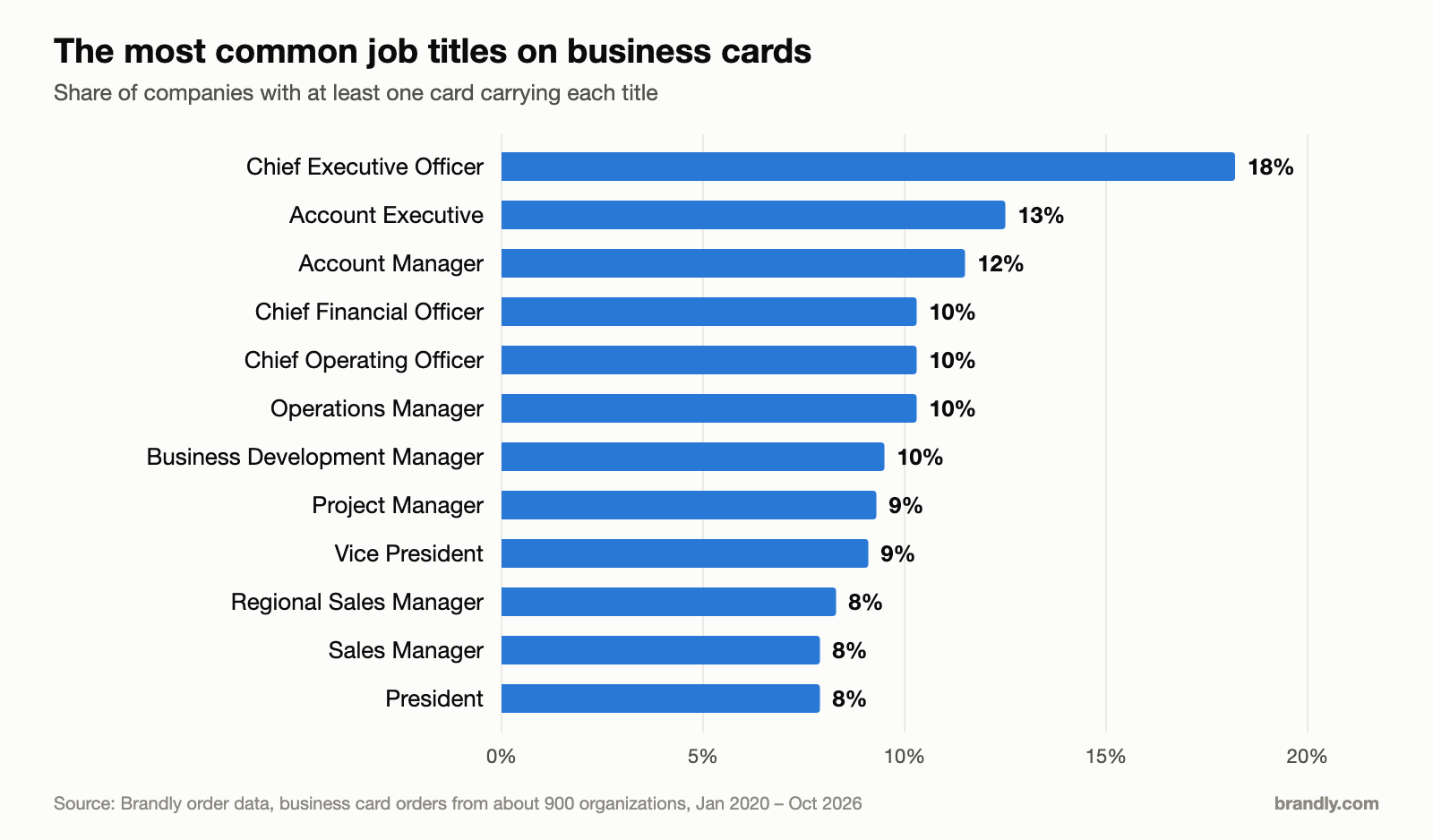
Chief Executive Officer is the title used at the most companies: 18% ordered at least one card with it. The CEO is often the first person to get cards, and sometimes the person who signs up for them.
After that, the list is mostly sales and operations. Account Executive (13%), Account Manager (12%), Business Development Manager, Regional Sales Manager and Sales Manager are all in the top 12. So are the other executives who meet customers, investors and partners: the CFO, COO, President and Vice President.
Titles are long and specific. Companies in the sample used more than 30,000 different titles, and the average title is about three words, like “Senior Project Manager” or “Director of Operations.”
Who gets business cards, by seniority
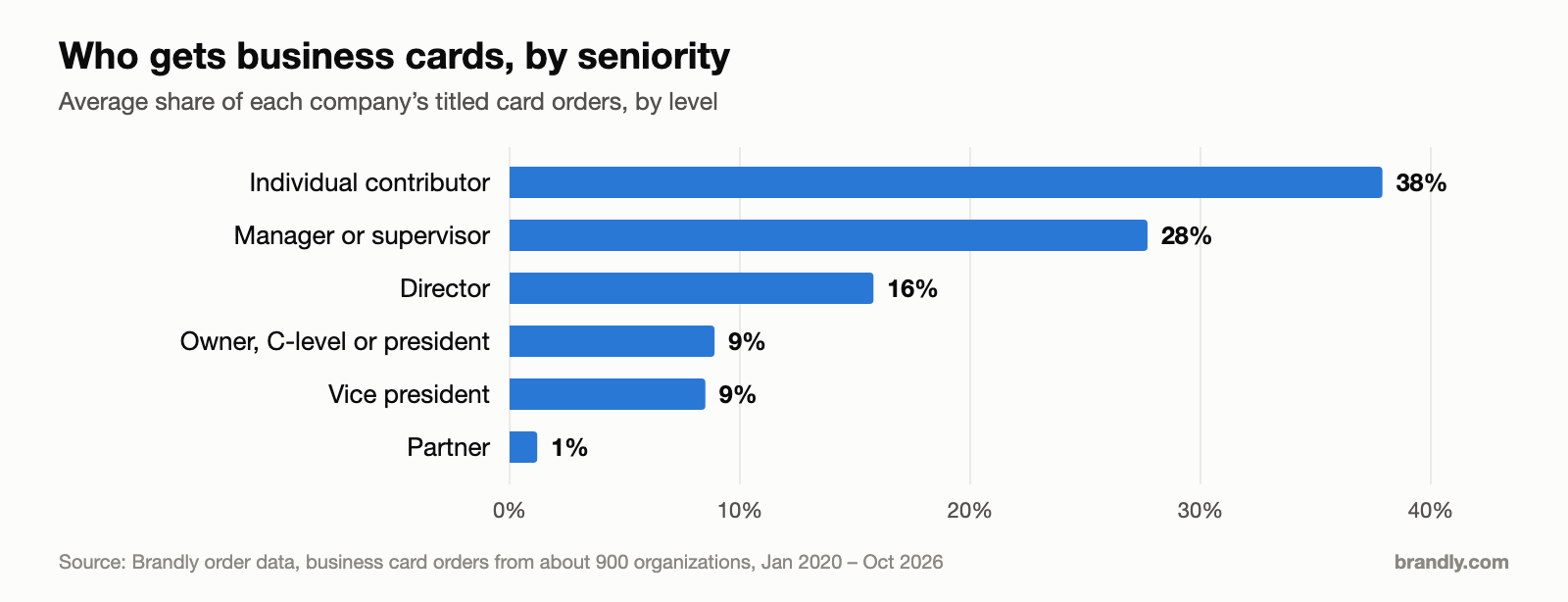
Business cards aren’t an executive perk. At the average company, individual contributors get 38% of cards, and managers and supervisors another 28%. Directors get 16%. Owners, C-level executives and presidents get 9%, and vice presidents another 9%.
By function, sales is the biggest group, at about a quarter of the average company’s cards. Operations and project roles, marketing and engineering follow, far behind. The rest is a long tail of specific roles, such as technicians, coordinators, nurses and recruiters.
Titles are also inching up. Titles that start with Senior, Lead, Principal or Staff went from 11% of the average company’s cards in 2020–2022 to 13% in 2025–2026.
If your company only gives cards to leadership, it’s behind most companies in this data. See why companies give business cards to all employees.
The most common titles in each industry
| Industry | Most common titles (% of companies) |
|---|---|
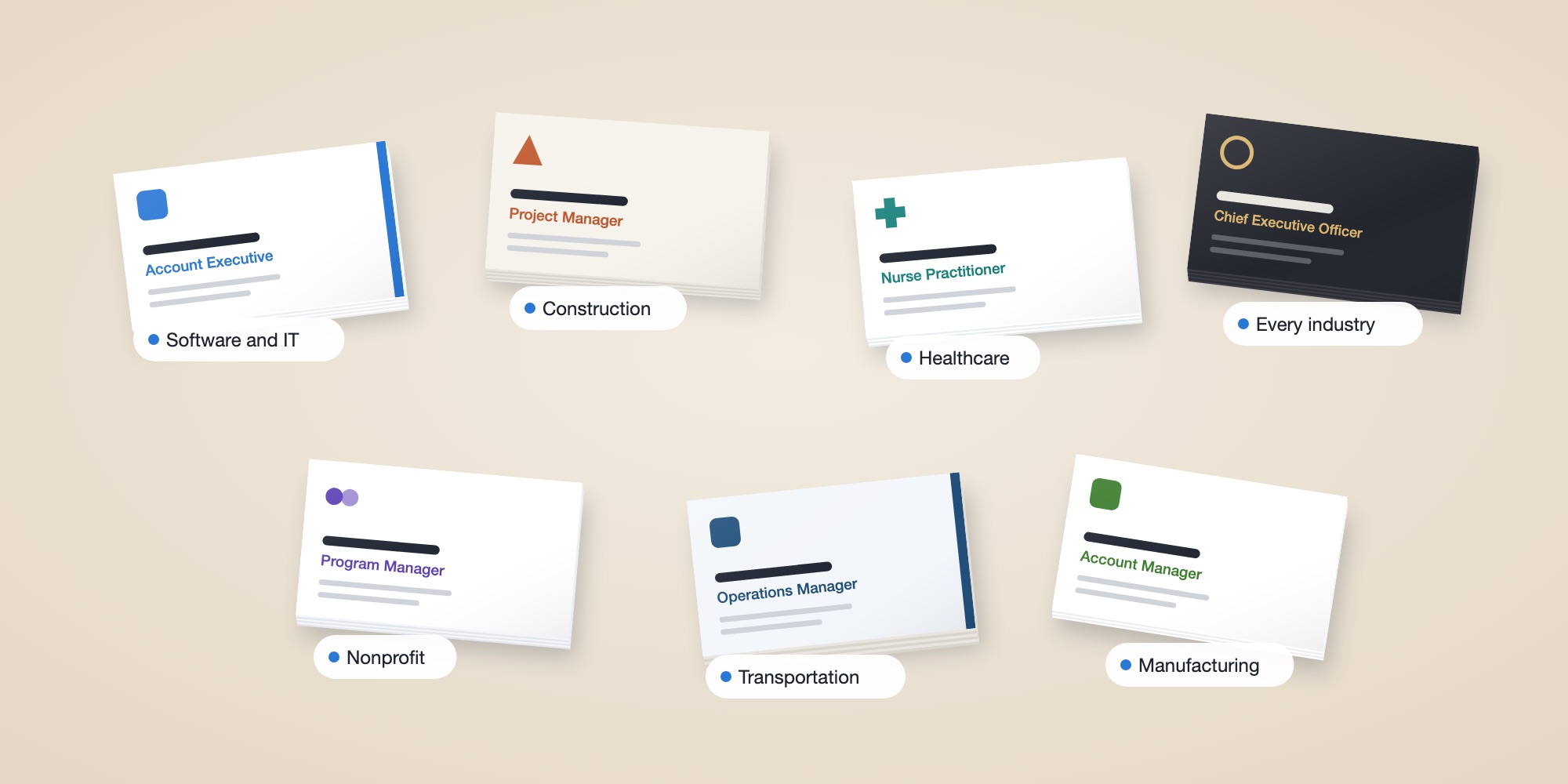
| Software and IT | Account Executive (36%), Enterprise Account Executive (26%), CEO (24%) |
| Manufacturing and industrial | Business Development Manager (23%), Account Manager (21%), CEO (20%) |
| Professional services | CEO (22%), Account Manager (15%), Business Development Manager (15%) |
| Finance and insurance | Account Executive (15%), CEO (15%), COO and Vice President (13% each) |
| Retail, consumer and hospitality | CEO (17%), General Manager, Marketing Manager and Operations Manager (15% each) |
| Construction and real estate | Project Manager (23%), Operations Manager (19%), Vice President (17%) |
| Healthcare | CEO (22%), CFO, COO and Nurse Practitioner (18% each) |
| Energy, utilities and environment | Project Manager (36%), Senior Project Manager (30%), CEO and Operations Manager (28% each) |
| Life sciences and medical devices | CEO (33%), CFO and Regional Sales Manager (21% each) |
| Nonprofit and government | CEO (21%), COO and Program Manager (17% each) |
| Transportation and logistics | Operations Manager (31%), CEO and Director of Sales (24% each) |
| Education | President (20%), CEO (13%), Admissions Counselor (10%) |
Each industry’s list says something about how it sells:
- Software companies run on account executives. More than a third have at least one Account Executive card, and a quarter have an Enterprise Account Executive.
- Project-based industries put project managers first. In construction, real estate and energy, Project Manager is the top title, and in energy, Senior Project Manager is second.
- Manufacturers lead with business development and account management, the people who win and keep distributor and customer relationships.
- Healthcare cards are clinical as well as executive. Nurse Practitioner is as common as the CFO and COO.
- Education is led by presidents, not CEOs, and admissions counselors are among the most common cardholders.
Which industries order the most business cards
| Industry | Card orders per company vs. typical company | Premium paper | Boxes of 250 or more | Added a digital card or QR (2025–2026) |
|---|---|---|---|---|
| Healthcare | 1.5× | 63% | 41% | 8% |
| Transportation and logistics | 1.5× | 84% | 42% | 22% |
| Manufacturing and industrial | 1.3× | 80% | 36% | 16% |
| Energy, utilities and environment | 1.3× | 84% | 38% | 26% |
| Finance and insurance | 1.1× | 86% | 49% | 15% |
| Retail, consumer and hospitality | 1.1× | 79% | 43% | 11% |
| Nonprofit and government | 1.1× | 60% | 29% | 6% |
| Construction and real estate | 1.0× | 74% | 42% | 13% |
| Life sciences and medical devices | 1.0× | 83% | 34% | 20% |
| Software and IT | 0.9× | 88% | 33% | 12% |
| Professional services | 0.9× | 79% | 35% | 12% |
| Education | 0.6× | 64% | 21% | 3% |
“Card orders per company” compares how many card orders a typical company in each industry places in a year with the typical company overall (1.0×). The other columns are averages per company.
Healthcare and transportation companies order the most cards, about 1.5 times as many a year as the typical company. Both have large field teams, such as clinicians, care coordinators, drivers, dispatchers and terminal staff, who meet patients and customers in person. Manufacturing and energy companies, with sales reps and field crews spread over large territories, order about 1.3 times as many.
Education orders the fewest, about 0.6 times the typical company, and the smallest boxes: only 21% of orders are 250 cards or more. At schools and colleges, cards likely go to administrators and admissions staff rather than the whole faculty.
Finance companies order the biggest boxes. Nearly half of their orders are 250 cards or more. Advisors, loan officers and insurance agents hand out cards constantly. For larger teams, see bulk business cards.
Digital business cards are catching on fastest in energy, transportation and life sciences, where about 1 in 5 to 1 in 4 companies that ordered in 2025–2026 added a digital card or QR code. They’re least common in education and at nonprofits. See QR code business cards that save your contact.
Which industries choose premium paper
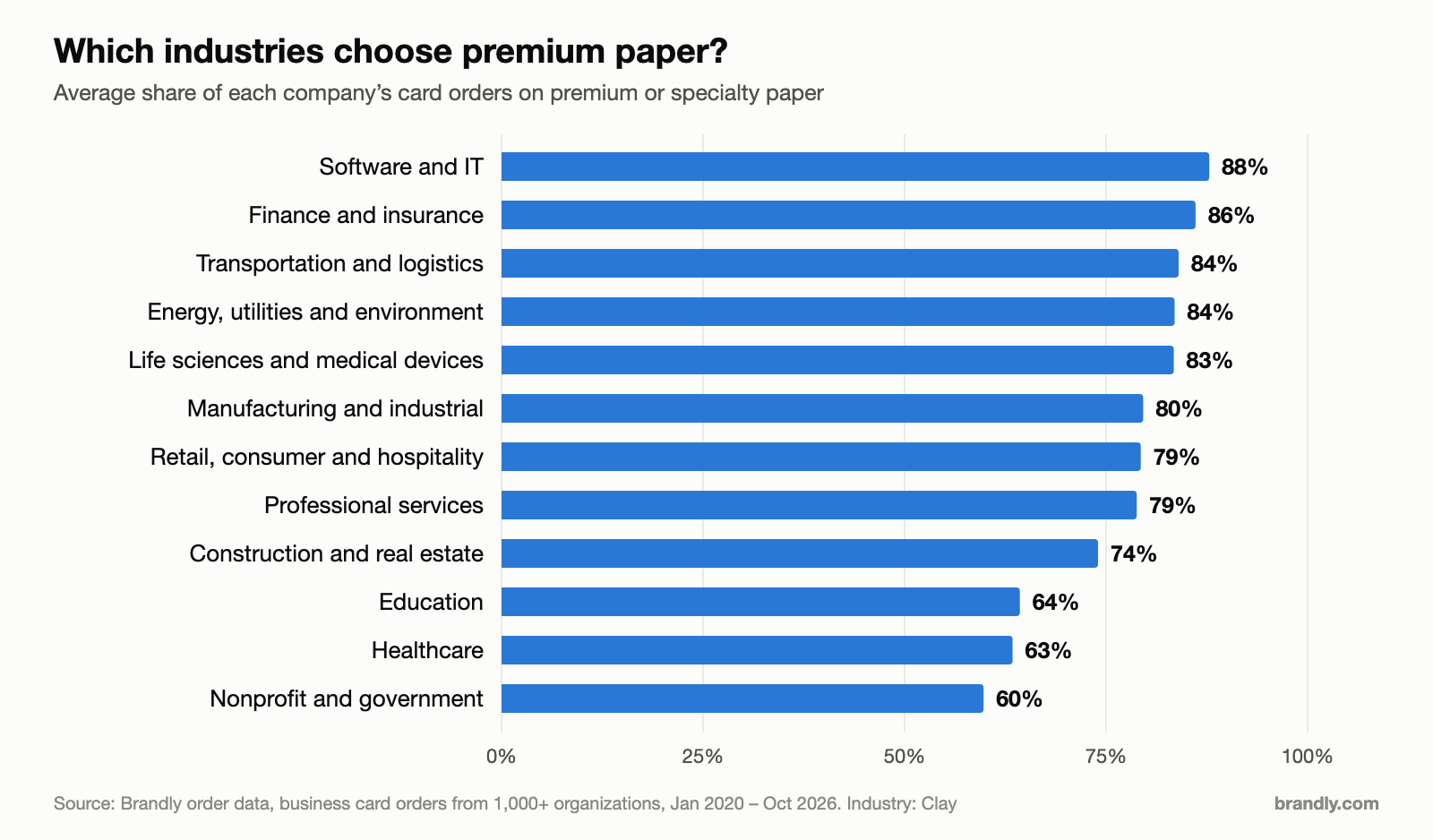
Software and finance companies are the most likely to choose premium paper, at 88% and 86% of the average company’s orders. In both, cards go mostly to salespeople and advisors, and a card that feels substantial supports a premium price.
Nonprofits, healthcare and education are the least likely, at 60% to 64%. These are budget-conscious organizations that order a lot of cards for many staff, so standard paper keeps the cost per person down. Even so, most of their orders are on premium paper.
For the differences between stocks, see how to choose a business card paper.
What’s printed on cards, by industry
| Industry | Sales roles | Owners, C-level and presidents | Street address | Credentials | Pronouns |
|---|---|---|---|---|---|
| All companies | 25% | 8% | 24% | 4% | 2% |
| Software and IT | 35% | 10% | 12% | 1% | 1% |
| Life sciences and medical devices | 34% | 8% | 21% | 8% | 2% |
| Retail, consumer and hospitality | 32% | 7% | 24% | 2% | Under 1% |
| Transportation and logistics | 31% | 8% | 31% | 0% | 0% |
| Manufacturing and industrial | 28% | 6% | 26% | 1% | Under 1% |
| Professional services | 23% | 11% | 33% | 6% | 3% |
| Finance and insurance | 22% | 9% | 32% | 1% | 0% |
| Construction and real estate | 19% | 5% | 25% | 4% | 0% |
| Healthcare | 17% | 6% | 29% | 20% | 8% |
| Energy, utilities and environment | 15% | 10% | 38% | 1% | 2% |
| Nonprofit and government | 5% | 5% | 20% | 8% | 16% |
| Education | 4% | 9% | 13% | 10% | 6% |
Each column is the average share of a company’s card orders. A few patterns stand out:
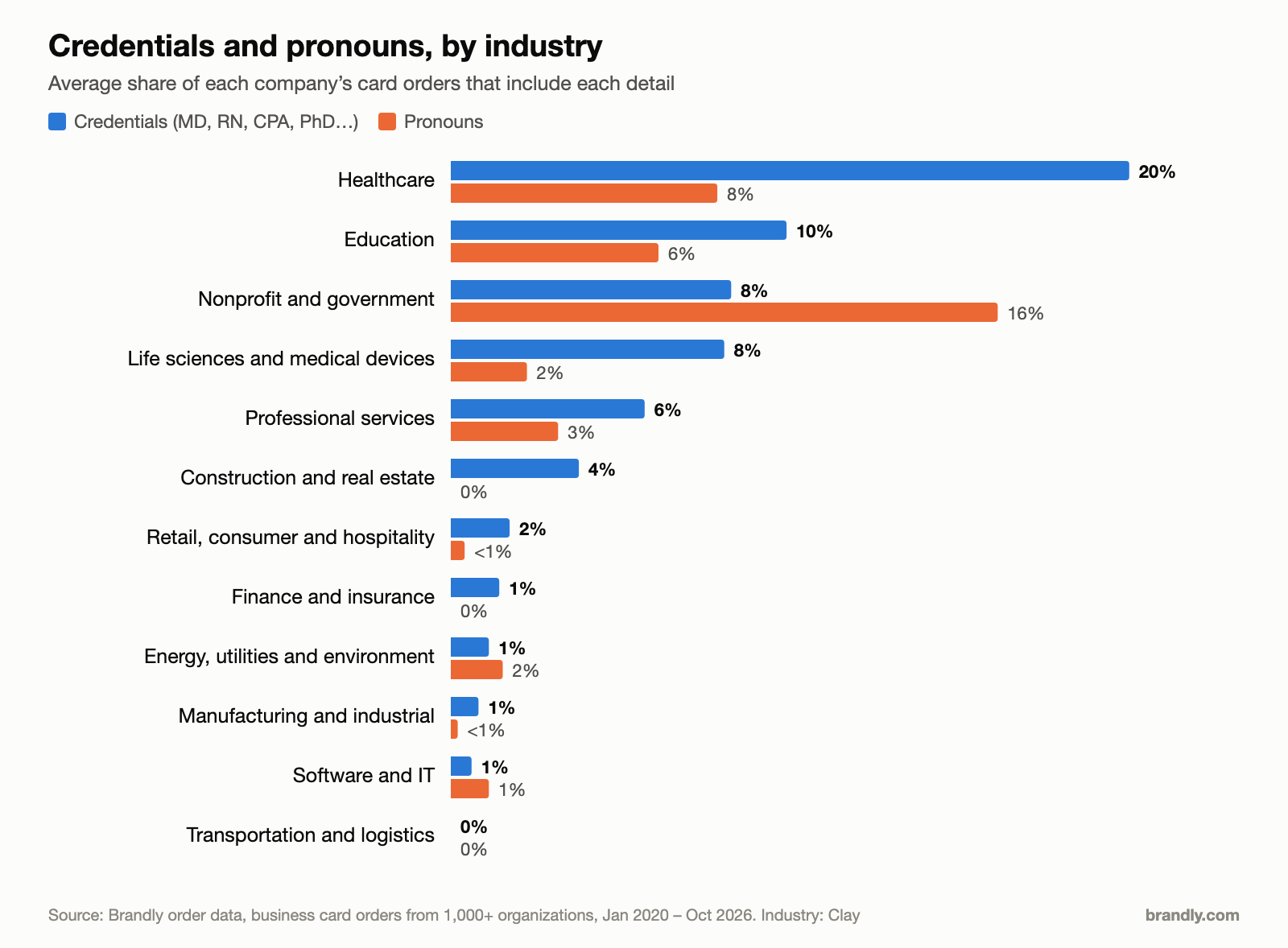
- Credentials belong to healthcare. One in five healthcare cards carries credentials such as MD, RN, NP or LCSW, five times the average. Patients and referral partners look for them. Education (10%) and nonprofits (8%) are next, mostly degrees and counseling licenses.
- Pronouns are a nonprofit habit. 16% of nonprofit and government cards include pronouns, twice the rate in healthcare and many times the rate in business. In finance, construction and transportation, almost no one prints them.
- Software cards are the most minimal. Only 12% include a street address, the lowest of any industry, which fits remote and hybrid teams. Energy (38%) and professional services (33%) are the most likely to print one, likely because clients visit their offices and sites.
- Sales titles dominate in software, life sciences and retail, at about a third of cards. At nonprofits and in education, sales roles are only about 5%.
For what to include in your own field, see what to put on a business card, by role.
- CEO is the most common title (18% of companies), followed by Account Executive (13%) and Account Manager (12%).
- Two-thirds of cards go to individual contributors and managers, and about a quarter to sales roles.
- Healthcare and transportation companies order the most cards; education the fewest.
- Software (88%) and finance (86%) choose premium paper most; nonprofits (60%) least.
- Healthcare cards carry credentials five times as often as average; nonprofits are the most likely to print pronouns.
Using these statistics
You’re welcome to quote these numbers and use the charts. Please credit Brandly and link to this page:
Source: Brandly, Business Cards by Industry: Job Titles and Habits from 1,000+ Companies (2026).
Business cards by industry FAQs
What is the most common job title on a business card?
Chief Executive Officer. In Brandly’s order data, 18% of companies ordered at least one card with that title. Account Executive (13%) and Account Manager (12%) come next, followed by Chief Financial Officer, Chief Operating Officer, Operations Manager and Business Development Manager at about 10% each.
Which employees get business cards?
Mostly people who meet customers. At the average company, about 38% of titled cards go to individual contributors, 28% to managers and supervisors, 16% to directors, 9% to owners, C-level executives and presidents, and 9% to vice presidents. About a quarter of cards go to sales roles.
Which industries order the most business cards?
Healthcare and transportation companies order the most: about 1.5 times as many cards a year as the typical company in the sample. Manufacturing and energy companies order about 1.3 times as many. Education orders the fewest, about 0.6 times the typical company.
Should I put credentials or pronouns on my business card?
It depends on your field. Credentials are on 20% of healthcare companies’ cards and about 10% in education, but on 1% or less in software, finance and manufacturing. Pronouns are most common at nonprofits and government organizations (16% of cards) and in healthcare (8%), and rare elsewhere.
Can I use these statistics?
Yes. Please credit Brandly and link to this page, for example: “Source: Brandly, Business Cards by Industry: Job Titles and Habits from 1,000+ Companies (2026).”
The takeaway
Business cards go to the people who meet customers: salespeople, account managers, project managers and the executives who close deals, not just the CEO. What goes on the card depends on the industry. Healthcare cards carry credentials, software cards drop the address, finance companies order big boxes on premium paper, and nonprofits print pronouns. Whatever your industry, the goal is the same: every employee’s card should look like it came from the same company. With Brandly, you set the design once, and every employee orders cards that match, with their own title on them.